Teutonic Knight
-
Posts
344 -
Joined
-
Last visited
Content Type
Profiles
Forums
Events
Gallery
Everything posted by Teutonic Knight
-
I'm in a rush now so I can't respond but the Zionists actually support your theory. They say Armenians are aboriginals of the region along with the Caucasians and Azeris, except that they happen to speak an IE language imposed on the native Armenians by invaders while the Azeris speak a Turkic language imposed on them by invaders. Hurrian had it's offshoot Urartian, non-IE language. And there is no IE langauge in the region besides Hittite and it's offshoot Luwian. before that there was Hattic another non-IE langauge. So where was the Armenian IE langauge back then?
-
Paron Highlander, if we assume that the IE homeland was indeed South-East of the Black Sea than the Armens moved to the Balkans along with the Hellenes, Phrygians and Thracians and then made their way back to their homeland via the Bosphorus as a result of the Torjan War. http://hyeforum.com/index.php?showtopic=9631&st=20
-
155 children slaughtered, 300 wounded by 10 arabs, one negro and about a dozen chechen/ingush. Putin should drop a few nukes on meccah and medinah and annihilate every single animal in the Caucasus. Most messed up thing ive read in a while: Killers Set Terms, a Mother Chooses Fri Sep 3, 7:55 AM ET Add Top Stories - Los Angeles Times to My Yahoo! By Kim Murphy Times Staff Writer BESLAN, Russia — Zalina Dzandarova cradles her son Alan as he sleeps with his small face buried against her stomach. He is the child Dzandarova was able to save. The child she chose to save, really. • Latimes.com home page • Subscribe to the Los Angeles Times It is the other one, little Alana, her 6-year-old daughter, whose image torments her: Alana clutching her hand, Alana crying and calling after her. Alana's sobs disappearing into the distance as Dzandarova walked out of Middle School No. 1 here Thursday, clutching 2-year-old Alan in her arms. Guerrillas armed with automatic rifles and explosive belts who are holding hundreds of hostages at the small provincial school in southern Russia allowed 26 women and children to leave. About a dozen mothers, like Dzandarova, were allowed to take only one child, forced to leave another behind. "I didn't want to make this choice," a stunned-looking Dzandarova, 27, said in the reception room of her father-in-law's house a few miles from the school. "People say they are happy that my son and I are saved. But how can I be happy if my daughter's still inside there?" Violence often selects its victims randomly, but seldom is a mother asked to make a Sophie's choice: Save one child and leave behind another, possibly to face death. The standoff in North Ossetia republic involving about 20 guerrillas — most likely linked to the neighboring separatist republic of Chechnya (news - web sites) or adjacent Ingushetia — has stunned a nation accustomed to war and its horrors after the many ethnic and territorial conflicts that accompanied the breakup of the Soviet Union. Even with the downing of two Russian jetliners and two street bombings coming in just one week, the thought of schoolchildren surrounded by veiled female suicide bombers and masked guerrillas has traumatized the country. "They Have Taken Hundreds of Our Children," read a banner headline in the daily newspaper Izvestia. And they took Alana. "They said they would let us go only after the [Russian] troops are withdrawn from Chechnya," said Dzandarova. She said the attackers had identified themselves as Chechens. "I said we have nothing to do with that, but they wouldn't listen." Her description provided one of the first accounts of what was happening inside the school, where Dzandarova said as many as 1,000 children and parents were being held in a gymnasium planted with explosives. Authorities officially listed the number of hostages at 354, a figure Dzandarova disputed. "The director of the school was taken to a TV where they were saying there were 354 of us in here, and the director came back and she was in a state of shock, because there were in fact many more people there," she said. "There were definitely 1,000 people in that one room," she said, referring to the gym. "I saw it with my own eyes." On Wednesday, Dzandarova took her daughter to the first day of first grade. As students and parents began lining up, they saw the attackers sweeping into the school. Dzandarova ran with her children to hide in a classroom, but they were rounded up with the others and taken to the gym. "Everyone was ordered to sit down, and they began to set up booby-traps around the perimeter, right in front of our eyes. They had lots of guns and explosives with them." At first, she said, everyone was allowed to drink water from the tap. But the hostage-takers soon stopped that, she said, because they were angry that officials, including the presidents of North Ossetia and Ingushetia, had not come to meet with them. Without water, the powdered milk the guerrillas supplied for the children had to be spooned into their mouths. The gym was sweltering, even after the window panes were broken out. "They were telling us, 'Your government is not allowing enough water for your kids.' " In just two days, she said, the problem became acute. "You see, the kids won't survive these negotiations," she said. "They're not getting enough water. What we have to hope is that they'll survive this night without water." At the beginning, 20 men in the gym were led to a different room. On Thursday, Dzandarova said, 10 of the men returned. The hostages presumed that the others were dead. "They told us that it was 'your own side' that had executed them, who had shot them dead," Dzandarova said. Two women who had been wearing suicide belts apparently detonated them Wednesday in an adjoining room, she said. "They left the gym, and all of a sudden we heard two loud explosions. We thought the storming [by Russian police] had begun. But then they told us, 'Our sisters have won a victory, and there's no other cause they want to pursue.' " The male guerrillas, she said, "took it calmly." Much of the time, she said, the guerrillas appeared tense: running around the room, waving their guns in the hostages' faces, shouting at them to sit still and stop talking. When Alan began to cry from hunger, Dzandarova was allowed to join several other mothers in an adjacent room, which had its own water and was several degrees cooler. After a former local political leader visited the school Thursday, the women in the adjacent room were told there was "good news": They would be released. "They said, 'Pack your things quickly, and take your babies with you,' " Dzandarova said. Shortly after, she learned that she would have to choose between taking her son or her daughter. Dzandarova had both Alan and Alana with her and made a snap decision to pass Alana to her 16-year-old sister-in-law. But the guerrillas saw through the ruse and refused to allow her to take the older child. "Alana was clinging to me and holding my hand firmly. But they separated us, and said: 'You go with the boy. Your sister can stay here with her.' I cried. I begged them. Alana cried. The women around us wept. One of the Chechens said: 'If you don't go now, you don't go at all. You stay here with your children … and we will shoot all of you.' " She couldn't save both of them. She could only die with both of them — or save one of them and herself. "I didn't have time to think what I was doing," she said. "I pressed Alan even stronger to myself, and I went out, and I heard all the time how my daughter was crying and calling for me behind my back. I thought my heart would break into pieces there and then." Dzandarova cried as she talked. Her tears fell on Alan, who was sleeping. Even when his mother shook quietly with sobs as she cradled him, he didn't awaken.
-
Replace Persians with Hellenes and it's more accurate. What you're describing is only the Eastern part of Armenia. In any case it's better to leave the pre-islamic Persian influence as it gave glorious names such as Vartan (Vardanes), Anahit, Ervand (Orontid) etc. Even the extreme Armenocentrics from Armenia always tell me how do you know it wasn't the Persians who took the names from Armenia But the semitic and turkic crap must go for your futures sake along with the post-pisslamic persian filth and the caucasus mountain tribal mentality leftover from the likes of georgians, chechens etc.
-
Well the Mongols needed an ally badly. We all know what happened. The Mamelukes massacred the combined forces of Armenians, Mongols and Georgians several times.
-
Neither. Although Armenian ("Eastern") is much much closer than the language spoken by Diasporans in its various incarnations. Grapar sounds like Gaelic.
-
Gamavor, if you were a deity, i'd worship you.
-
Armenian medals in Athens: WR - Men's Greco-Roman 74kg SAMOURGACHEV Varteres Bronze RUS WR - Men's Greco-Roman 84kg ABRAHAMIAN Ara Silver SWE WR - Men's Greco-Roman 60kg NAZARIAN Armen Bronze BUL WR - Men's Greco-Roman 66kg MANUKYAN Mkkhitar Bronze KAZ WR - Men's Greco-Roman 55kg KIOUREGKIAN Artiom Bronze GRE Fencing - Women's Team Epee AZNAVURYAN Karina GOLD RUS Gold -1, Silver 1, Bronze 4 Total 6
-
Armenia Builds Up Its Military Might
Teutonic Knight replied to Teutonic Knight's topic in Republic of Armenia
По словам источника газеты в ОПК, новая разработка военных ученых превосходит по своим характеристикам американский ЗРК Patriot. Как пишет газета, "Самодержец" способен "оставить позади навсегда" иностранные аналоги. На вопрос газеты, не является ли появление такой техники новым витком гонки вооружений, источник ответил: "Скорее наоборот, поскольку догонять «Самодержца» - бессмысленно". Разработка является универсальной, сочетает в себе лучшие характеристики предыдущих разработок и, по замыслам проектировщиков, станет базой для принятия решения по созданию "единой зенитной ракетной системы" для всех видов войск. В основу "Самодержца" положены наработки всех научно-исследовательских институтов ОПК, которые занимаются противовоздушной и противоракетной обороной, в процессе исследований были задействованы военные представительства и генеральные заказчики. -
Yeap. You may report back to your shaman.
-
Armenia recently got several S-400's. Nothing, not even Patriots can do anything about them. Ankara can be obliterated from Yerevan in a few hours. Agency WPS DEFENSE and SECURITY (Russia) August 27, 2004, Friday ARMENIA BUILDS UP ITS MILITARY MIGHT SOURCE: Voyenno-Promyshlenny Kurier, No 32, August 25 - 31, 2004, p. 2 by Samvel Martirosjan (Yerevan) ARMENIA BUILDS UP ITS MILITARY MIGHT AGAINST THE BACKGROUND OF THE DEEPENING CRISIS IN THE RELATIONS WITH AZERBAIJAN THAT THREATENS WITH FULL-SCALE WAR The Russian-Armenian military cooperation develops quite dynamically. Not long ago, Russia lent a sympathetic ear to Armenia's request concerning training of up to 150 officers. Complicated situation in the Caucasus forces the authorities of Armenia to pay unfeigned attention to national defense. According to official data alone, the 2004 Armenian state budget allocated almost $82 million for military needs, an almost 10% rise against war spendings in 2003. Estimates of the International Institute of Strategic Studies (London) show that in 2002 Armenia was the CIS leader in the arms spendings to GDP ratio - 6.4%, an equivalent of $162 million. The CIA claims that as far as this particular parameter is concerned, Armenia is the 11th in the world; it spent $135 million on its army in 2001. When the closed parliamentary hearing of fulfillment of the 2003 budget was over not long ago, Armenian Defense Minister Serzh Sarkisjan said that arms spendings would be increased next year again. Sarkisjan refused to elaborate but said that the Armenian national army was initiating a program of rearmament. It should be noted that the population of Armenia, not exactly a wealthy country, does not object to these measures taken by national leaders. The population is perfectly aware of the undeclared war with Azerbaijan that is under way. Serious clashes are regularly reported in the areas where Armenian and Azerbaijani troops face each other; shots have been fired by sharpshooters for a decade (ever since the cease-fire on the Artsax front was signed). Moreover, official Yerevan positions itself as a guarantor of security of Artsax. Turkey is another potential enemy. Diplomatic relations with Turkey have never been established. Ankara is still blocking the border with Armenia and pursuing an openly anti-Armenian policy. Sociologists of the Armenian Center of National and Strategic Studies discovered that 47.5% respondents in Armenia believe that the war with Azerbaijan may be resumed within five years, and 7% more expect a Turkish aggression within the same span of time. Figures Armenian national army is considered one of the most combat ready in the Caucasus. These days, it is over 60,000 men strong. According to the CIA, there are 810,000 men in Armenia aged 15 to 59 and almost 650,000 of them are fit for combat. Most experts say, however, that mobilization resources of Armenia amount to 300,000 men, i.e. almost 10% of the total population (over 3.2 million). Under the Treaty on Conventional Arms in Europe, in 2001 Armenia declared 102 T-72 tanks and 204 armored vehicles (most of them infantry fighting vehicles and armored personnel carriers). With the military hardware the Treaty on Conventional Arms in Europe does not apply to, Armenia has up to 700 armored vehicles. Its artillery comprises 225 pieces of 122 mm and larger calibers including 50 multiple rocket launchers. The Armenian Air Force includes five SU-25 ground-attack aircraft, one MIG-25, 35 helicopters (the latter include twelve MI-24 attack helicopters), and 3,000 servicemen. Yerevan intends to build up this component of its Armed Forces. Not long ago, Defense Ministry of Slovenia proclaimed the sale of ten SU-25s to Armenia (nine SU-25K one-seaters and one SU-25UBK two-seater). The consignment will cost Armenia $1 million. Armenia bought two IL-76 military transports from Russia not long ago. The transports were bought at Russian domestic prices and made it to Armenia together with Defense Minister of Russia Sergei Ivanov. Armenia builds up its Air Force in the hope of making it a match for the Azerbaijani, but its antiaircraft defense is considered the best throughout the Caucasus. Armenian antiaircraft defense comprises an antiaircraft missile brigade and two regiments armed with almost 100 antiaircraft complexes of various models and modifications (Osa, Krug, S-75, and S-125). Numerical strength is estimated at about 2,000 servicemen. Armenian antiaircraft defense developed in a hurry in the war over Artsax when Azerbaijani Air Force regularly and energetically bombarded Armenian trenches and settlements both in Artsax and in Armenia's own border districts. There was nothing Armenia could do about it then. By 1993, however, it already had a formidable antiaircraft defense in Armenia itself and in the Republic of Nagorno-Artsax. Its deployment cut Azerbaijani advantage in the sky to the minimum. These days, the Armenian skies are controlled by Armenian and Russian antiaircraft defense units on joint combat duty since 1999. There are at least 30 MIG-29 fighters and a regiment of S-300s quartered on the territory of Armenia. Allies in the Organization of the CIS Collective Security Treaty Armenia is a member of the Organization of the CIS Collective Security Treaty. As such, it participates in all events organized within its framework. In any case, Russia is Armenia's oldest and traditional ally. Ever since the regaining of sovereignty, the tandem of Moscow and Yerevan has served as one of the few examples of bona fide military-political cooperation in the Commonwealth. There is practically no discord between Russia and Armenia in this sphere. Russia and Armenia together defend the Armenian airspace or, rather, the southern border of the Commonwealth. Armenian borders with Turkey and Iran are manned by almost 2,000 Russian bodyguards who serve shoulder to shoulder with their Armenian counterparts. Yet, it is the 102nd Military Base in Gyumri that is Russia's major outpost in Armenia. Unlike Tbilisi or Baku, official Yerevan never brings up the subject of withdrawal of the Russian troops. When Sarkisjan is asked the question, he never answers believing it a rhetoric question. Armenian society regards the Russian troops as a covering force defending it from the Turkish aggression. Until recently, the 102nd Military Base had 74 tanks, 17 battle infantry vehicles, 148 armored personnel carriers, 84 artillery pieces, up to 30 MIG-23s and MIG-29s, and a regiment of S-300 antiaircraft complexes. In the last eighteen months, however, a great deal of military hardware was moved there from Georgia. Armenia gave the land and objects used by the 102nd Military Base over to Russia and covers some communal services. Officer training is another sphere of Russian-Armenian military cooperation. In the first years of sovereignty when Armenia did not have military educational establishments of its own, officers of its army were trained in Russia. Even now when Armenia has a military college on its own territory, the Armenian officer corps honors the tradition and is trained at Russian military educational establishments. On a visit to Armenia in late May, Ivanov said that 600 Armenian servicemen are being trained in Russia. "Armenia asks for the permission to send 150 servicemen to Russia in 2005, and Russia gave its consent," Ivanov said. It seems that Moscow and Yerevan do not plan to stop. The first meeting of the joint Russian-Armenian government panel for military-technical cooperation will take place this autumn. According to Prime Minister Mikhail Fradkov, Russian factories will participate in the Armenian program of military hardware modernization. He even said that Russia is prepared to supply the necessary spare parts an equipment. Belarus is another ally of Armenia in the Organization of the CIS Collective Security Treaty. The two countries signed a treaty in 2002. Under the document, Armenia will receive light weapons, armored vehicles, ordnance, and optical devices in return for spare parts and gadgets for military hardware. Armenia also intends to have its heavy military hardware upgraded at Belarusian factories. Lieutenant General Sergei Gurulev, Chief of the General Staff of the Belarusian Armed Forces, says that the Armenian-Belarusian military contacts "become systematic and deliberate." Do not forget NATO Greece is Armenia's best ally in the Alliance. Greece and Armenia share ancient ties and a common enemy - Turkey. Armenian officers are trained in Greece. Every now and then Athens puts into motion military aid programs. In 2003, the two countries signed another military cooperation accord under which Greece will up the number of Armenian servicemen trained at the military and military-medical academies in Athens. Armenia became a peacekeeper in February. It sent 34 servicemen to Kosovo where they became an element of the Greek contingent. Armenian servicemen in Kosovo are paid by the Greeks. Yerevan has been shifting towards NATO lately, mostly within the framework of the NATO's Partnership for Peace Program. Cooperative Best Effort exercise (the first one where Russia was represented) was run on the territory of Armenia in 2003. Armenian cooperation with NATO is mostly declarative for the time being, but the United States - the country steadily upping its clout with countries of the region - has far-reaching plans with regard to Yerevan. In early 2003, the Pentagon announced several major military programs in the Caucasus. Washington's military aid to Armenia in 2004 will amount to $5 million even though the US Administration intended to restrict it to $2 million at first. Armenia and the United States signed a military-technical cooperation accord in April. Some articles in the American media imply that the accord specifies the use of Armenian airfields by the US AF. Proclaiming complementariness as its foreign political doctrine, official Yerevan never misses a chance to advance its contacts with Washington. When the war in Iraq was under way, Armenia remained neutral. It neither supported the war and America's action nor condemned them. These days, however, the parliament and government of Armenia are working on the legislation that will enable Yerevan to send servicemen to Iraq. The Cabinet already endorsed the decision of the Defense Ministry to subscribe to the memorandum "On the command and settlement of issues in connection with activities of the international division in the forces of coalition in Iraq". At first, Armenia will probably send 10 de-miners and 3 doctors and some trucks to Iraq. Moreover, Armenia even permitted the United States to modernize its communications, one of the most vulnerable items. Yerevan expects to get communications means from American companies. The deliveries will be paid for by the White House (the sum amounts to $7 million). Commenting on it, Sarkisjan said that Russia is quite understanding. "We are allies. It means that the strengthening of one partner will benefit the other," said Sarkisjan. "We initiated the process a year ago, and I found our Russian colleagues quite understanding." He said that from military cooperation with the United States Armenia expected to up combat potential of its own army. So, Armenia ups its military might against the background of the deepening crisis in the relations with Azerbaijan, the crisis that threatens to deteriorate into another full-scale war. It should be noted as well that in any conflict the Armenian national army may count on servicemen from Artsax. In fact, the Artsax army even leaves the Armenian behind in some parameters. Artsax armed formations cannot match the Armenian army in manpower (about 20,000 servicemen and mobilization resources at 60,000 men), but they are certainly ahead of Armenia in heavy military hardware: 316 tanks, 324 armored vehicles, 322 artillery pieces of calibers over 122 mm, 44 multiple rocket launchers, and the antiaircraft defense system that performed flawlessly in the hostilities in the 1990's. Translated by A. Ignatkin http://groong.usc.edu/news/msg92385.html
-
HAHA We have a badass mongol here
-
Those so called "studies" are conducted by jews, you expect them to be factual and reasonable? It's all bullshit. Some jews might have Armenian genes as a result of ancient Armenian incursions into the Middle East. Likewise they have an equal amount of Greek and Roman genes as well as pretty much genes from everyone else since they are a mongrel group of people, not a religion or a race. They come in all shapes and colors. I wouldn't worry about them moving to Armenia. They usually move to places where there are lots of dumb people. Hence the total number of jews in Armenia now isn't more than 500.
-
Westerners buy it, because there's really no Armenian oposition to this crap. http://www.stonepages.com/news/archives/000892.html
-
Interesting. It sounds so much more natural with L instead of GH.
-
I don't know about 2492 BC, but there is no indication that "Hayk" waited until Urartu's destruction to become the "ancestor". First, let's drop the pretense that Hayk was a real person. Probably almost all those mythical "person" names refer to the names of individual peoples (i.e. tribes), and the names of Haykazian "kings" symbolize the assimilation of those tribes into Hayk. The Hayk (people) were around before anyone had heard of Urartu, but part of their kin could have fallen under the rule of the Urartuan dynasty later. In any event, there is nothing of record that justifies the assignment of the fall of Urartu as the "proper" beginning of a "unified" Hay people. And if we need to associate "Bel" with a local tribe, how about the Palaic people? It is quite reasonable to think that the Hayk had to wage some sort of a struggle against the Palaic tribes (cousins and contemporaries of Hittites) in order to gain a coherent identity. No proof for any of this one way or the other, but the evidence fits the emergence of a coherent Hay identity long before the formation of the Urartu Kingdom, probably somewhere between 2000BC and 1400BC. And we didn't even touch the linguistic analysis of Gray & Atkinson yet, which would suggest a much earlier date for the isolation of a distinct group of proto-Hay speakers, if not a self-aware tribe. Hayassa have been around way before Urarteans but not Hurrians i'm talking about the unified nation of Armenia including everyone from Armens, Urarteans, Nairi etc.. A point after which no other nations or tribes were assimilated or added. For example the English become the English after the Norman conquest and remain the same to this day. Now regarding Gray & Atkinson. I always thought the Black Sea shores were related to IE culture and it's origin but that doesn't mean it was south of the Black Sea. Lets also put this into context with J.P.Mallory's, Pitman and Ryan etc. research. This is all very cute and novel, but it should not be taken as gospel. It's long been understood that glottochronology and lexicostatistical comparisons are not sufficient for presenting an accurate picture of linguistic change. Now G&A's research is to a great extent based on that of the anthropologist Luigi Cavalli-Sforza, who attempted to show some relation between genetics and language . Cavalli-Sforza's work has been widely regarded as a breach of the scientific method. Colin Renfrew postulated an Anatolian origin of IE several years ago, even publishing a book on it. He then retracted this hypothesis shortly after the book was published. Turks are having a field day with this. When this came out my local paper had this 'Origin of the English language comes from Turkey.' In any event, this research by Atkinson and Gray does nothing to further our knowledge about the Indo-European homeland. Considering that the Anatolian languages were probably in development long before any system of writing was developed for them, locating their origin around Catal Hayuk is problematic at best. Who's to say that the ancestors of the Anatolians, having made some break with other IE peoples well before any evidence of their languages appeared in written form, didn't migrate into Anatolia from elsewhere?
-
Yes but he was not considered the ancestor of the UNIFIED Armenian NATION because there was no unified Armenian nation until this period.
-
I support that. That's extremely reasonable. Check this out Gamavor: Pre-history: 90,000 BC to Paleolithic, Mesolithic and Neolithic periods. Metsamor civilization. http://www.tacentral.com/history.asp Period 1: Late Bronze Age a. Hayassa-Azzi (with the addition of Hittites, Luwians and other IE Anatolians) b. Rise of Hurro-Urartians c. Arrival of Thraco-Phrygian Armen tribes from Thrace Period 2: Separation of Proto-Armenian language from Proto-Greek and the appearance of Proto-Armenian in the northern areas of Anatolia, associated with Luwians and Hittites, in the period from 2200-1900 BCE. Period 3: The Urartu State Thenative Hurrian speaking people take the role of Western Peasants to the Hurro-Urartian Upper Class while Armen peoples seem to be associated with the Nairi. Period 4: The Scytho-Median overlordship The destruction of Urartu gives the Armen tribes the chance to expand and assume the mantle in the power vacuum of the Urartian state. This is the period in which Hayk becomes acknowledged as the "ancestor" of Hayassa. Period 5: Persian & later Hellenistic Period when the name Armeniya becomes acknowledged. This sees the emergence of Armenian as a literate language with an adapted and modified Aramaean/Greek script, for the first time. <Sarcasm> But no Hurrians and Urartians spoke an IE language, Hayk invented the wheel and horse riding and Sumerians were Armenians, did I mention Asrhakunis and Ervandunis were not from Persia? </sarcasm>
-
Hahaha. Martiros Kavoukjian belongs in a nuthouse. I have never read such ethnocentric insane garbage. He stopped short of claiming that his ancestors built the pyramids.
-
I've seen Greeks do a matagh exactly the same way. They marked the cross with the blood on the foreheads just like in Armenia too. Vochxari tptrtal@ mi kich t'ha& a, bayts erb aklorov en anum arandsnapes shat dajan tesaran chi.
-
Yeap, Bulgarians too.
-
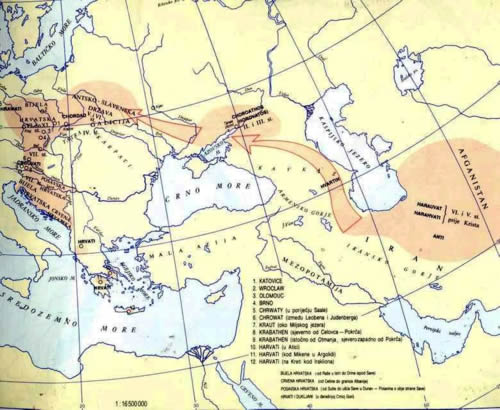
Armenian sympathy towards Serbs is laughable because to Serbs, Armenians are nothing but Armenoid freaks from kavkaz. The worst insult given to an Albanian by a Serb is Armenoid only then followed by Shiptar. Both Serbs and Croats could have ancient Iranian origins since neither names have any roots in Slavic but plenty in Iranian languages. The Hellenic and Roman texts support this as well. neither Croats or Serbs like to be associated in any shape or from with Iranians though for obvious reasons hence the popular theory among both people is that they originated in Boykiya (Ukraine). http://www.rastko.org.yu/antropologija/ljc...c_srbi_ukr.html
-
I'll give it a try. ~~~ Shmavon Altouneants Karapet Pholateants Karneci (from Karin, a town near Ghars) 1903 July 13th I have no idea how to translate "mtkic chancats". ...didn't get to meet and see because of fate with happiness we came to Ani. We're departing with sadness and leaving sparkles in Armenian hearts. Be well oh you Ani...ruin the house?
-
Մեխկ էն, ինչպէս ոչխարներ, որոնք հովիվ չունեն ...
-
I guess that explains me Btw when Serbs insult Croats or more often Albanians they call them Armenoids followed by something along the lines of "go back to Kavkaz". In reality it's quite possible that the Croats were an Iranian tribe. This map shows their migration.