Armine
-
Posts
178 -
Joined
-
Last visited
Content Type
Profiles
Forums
Events
Gallery
Everything posted by Armine
-
Mosjan vorpes abstract art kepanem.. It shows u took time out of ur life to do something personalized.... Like my nur with roses ... Nothing no matter how extravagant can replace it's meaning.
-
whatever happened to the old hand written thank you cards/notes?... I think its time to help them rise for the ashes. Good old fashioned way of showing gratitude, yet has so much power.
-
this is what is going through my mind... "lav at least these girls can perform on stage and have done long concerts that we have seen so they cant perform as bad as Sirusho... maybe it will sound better when its recorded not live... we loveeeed qele qele, but what about the actual singing when push came to shove.... these two are powerful... maybe theyll makes adjustments in the final recording... SOAD SOAD SOAD SOAD SOAD...." so you can see that I'm waiting to see where this will go.
-
How about the role of women in education, you can single out LA, and even conduct a few interviews after finding what great things Armenian women do in field of education in the Diaspora... just a thought.
-
here are some publications http://www.aiwa-net.org/Bibliog.html
-
Also, dont pick the topic before you read the existing sources... get as many primary and secondary sources possible, read, make categories and outlines, then decide what your specific argument will be based on how much evidence your have to prove your claims.. so if I were you I would make the bibliogaphy... start annotating what you find then form a argument. otherwise you spend you time trying to find sources to fit an argument rather then doing a real research that is true to your topic.
-
1.my first rec would be to go to Abril gratun on broadway in glendale... Hell have something for sure... maybe a section on women in a book about the diaspora... 2. check our some of these books - some of these are primary sources you can use as conclusive evidence of the changing role of women. The Other Voice: Armenian Women's Poetry Through the Ages by Diana Der-Hovanessian -Out of Darkness: An Armenian Woman's Story by Ramela Martin -Lion Woman's Legacy: An Armenian-American Memoir (The Cross-Cultural Memoir Series) by Arlene Voski Avakian -Voices of Armenian Women by Armenian Women's International Association (Paperback - 1992) -A History of Armenian Women's Writing 1880-1922 by Victoria Rowe (Paperback - Mar 4, 2009) -Armenian Women in a Changing World: AIWA International Conference, London, England, September 1994 [includes 'Armenian American Women Inhabiting Our Bodies: Engendered and Embodied Ethnicity in Carol Edgarian's Rise the Eurphates', 'Struggling for Life: The Legacy of Genocide and Armenian American Women', 'Speech Over Silence: The Pen and The Needle in Armenian Women's Autobiographies, 'Crossing Over to the Other Side' by Arlene Voski; Carol Edgarian; Flora A. Keshgegian; Gayane Karen Merguerian; Martha Ani Boudakian Avakian (Spiral-bound - 1994) -The Five Lives of Leah: The Saga of an Armenian-american Woman by Sarkis Takesian (Paperback - 2003) -The Red Rugs of Tarsus: A Women's Record of the Armenian Massacre of 1909 by Helen Davenport (Brown) Gibbons (Paperback - Oct 9, 2008) 3. get in touch with A rmenian I nternational W omen's A ssociation -- -they have publications hope thats helpful.
-
February 12, 2009 Rep. Adam Schiff Rep. George Radanovich Rep. Frank Pallone Rep. Mark Kirk New Drive for Armenian Genocide Resolution Launched Adam Schiff joined by George Radanovich and Armenian Caucus Co-Chairmen Frank Pallone and Mark Kirk in Seeking Bipartisan Support for Armenian Genocide Resolution WASHINGTON, DC - A letter seeking U.S. House cosponsors for a renewed drive to secure the adoption of the Armenian Genocide Resolution was circulated today on Capitol Hill by the legislation's lead authors, Congressman Adam Schiff (D-CA) and George Radanovich (R-CA), and Armenian Caucus Co-Chairmen Frank Pallone (D-NJ), and Mark Kirk (R-IL), reported the Armenian National Committee of America (ANCA). "We join today with millions of Armenians throughout the United States, in Armenia, and around the world in welcoming the launch of this new drive toward U.S. recognition of the Armenian Genocide," said Aram Hamparian, Executive Director of the ANCA. "It's always the right time to take a stand against genocide. Now - with longstanding advocates of this noble and necessary cause in the White House, leading the State Department, serving in the Cabinet, heading up both Houses of Congress, and chairing key Congressional committees - we are set to overcome the final barriers to full and formal U.S. recognition of the Armenian Genocide." In the letter, the four legislators invited their House colleagues to join the resolution as original cosponsors, which will mean that they will be listed as supporters starting from the day of its introduction. During the recently concluded 110th Congress, an identical measure secured the support of 212 cosponsors, was adopted by the Foreign Affairs Committee, but was eventually blocked from a vote on the House floor by sustained attacks by then-President George W. Bush and his Administration. In urging early support for this human rights measure, the four lead sponsors noted that, "By properly acknowledging the Armenian Genocide, we reaffirm the willingness of the U.S. to speak plainly about genocide, and renew our commitment to prevent other occurrences of man's inhumanity to man." The Armenian Genocide Resolution reaffirms the U.S. record on the Armenian Genocide by ensuring that the foreign policy of the United States reflects appropriate understanding and sensitivity concerning issues related to human rights, ethnic cleansing, and genocide documented in the United States record relating to the Armenian Genocide. Published by the Armenian National Committee of America 1711 N Street NW, Washington, DC 20036 Tel: (202) 775-1918, Fax: (202) 775-5648, E-mail: anca@anca.org, Web: www.anca.org
-
Battle over Armenian genocide museum in D.C. gets nasty -------------------------------------------------------------------------------- WASHINGTON — A nasty legal fight complicates plans for an Armenian genocide museum, and it shows no sign of abating. On Friday, attorneys for the warring parties who once were close allies met again in a District of Columbia courtroom. There was no peace agreement, only the prospect of many more months of wrangling. "The clients are very hostile to each other right now," attorney Arnold Rosenfeld advised a federal judge last year, a court transcript shows. Rosenfeld represents the Armenian Genocide Museum and Memorial Inc. On a site two blocks from the White House, the non-profit organization proposes to build "the premier institution in the United States dedicated to educating American and international audiences about the Armenian Genocide." The museum potentially has high appeal in regions with large Armenian-American populations. It's been discussed since the mid-1990s, and planners say they want the 35,000-square-foot facility open before 2011. But a bad falling out with a major donor has been diverting time, energy and money. The one-time donor, retired millionaire businessman Gerard Cafesjian, is suing to reclaim his donations. Cafesjian, in turn, is being sued by museum organizers for allegedly trying to interfere with their work. The competing lawsuits now resemble a bad divorce, where mutual rancor feeds on itself and prior intimacies become potential vulnerabilities. "I must say, I'm very irritated," U.S. District Judge Colleen Kollar-Kotelly warned lawyers in August, a court transcript shows. "These cases are not a good use of judicial resources and, frankly, probably not of your client's resources, either." On Thursday, in a ruling that keeps the lawsuits alive, Kollar-Kotelly nonetheless characterized them as "very unfortunate." "If you're disputing about money, it's going to become bitter," noted Barlow Der Mugrdechian, coordinator of the Armenian Studies Program at California State University, Fresno. "It's not going to go away soon." When completed, the museum will commemorate the events between 1915 and 1923, when by some estimates upward of 1.5 million Armenians died during the final years of the Ottoman Empire. Architects are already designing the project for the corner of 14th and G streets in downtown Washington. The city's Historic Preservation Review Board last year gave conceptual approval to use of the existing 83-year-old National Bank of Washington building. The Armenian Assembly of America initiated the museum planning and in 2003 secured an agreement with Cafesjian and the Cafesjian Family Foundation. There then followed a series of complicated transactions. The foundation granted and pledged roughly $15 million to help the Armenian Assembly buy the four-story National Bank of Washington building and four adjacent pieces of property. The donation included an agreement that if the museum isn't developed by Dec. 31, 2010, the Cafesjian foundation can get either its money or the property back. Cafesjian is a World War II Navy veteran who made his fortune as an executive at West Publications, a Minnesota company that handles legal publications. He is described by his supporters as a well-meaning benefactor. "Cafesjian has dedicated his largess to the Armenian people, Armenian nation, and Armenian causes," his attorneys stated in one legal filing. But problems became apparent by October 2006, when a Cafesjian ally filed legal documents that allegedly clouded the title of the museum property. The museum organizers subsequently claimed Cafesjian was "actively taking steps to delay the development" in hopes of regaining the property for his own purposes. Cafesjian filed his own lawsuit, claiming that the museum's board of directors deliberately shut him out from key planning decisions. "Unfortunately, rather than becoming more cooperative, relations among trustees were increasingly divisive," Cafesjian's attorneys summed up in one legal filing. The bitterness is apparent in voluminous legal filings. Museum organizers make Cafesjian out to be a profit-seeking egotist, as they described his plans for a giant "Cafesjian Art Museum" next door to a "grandiose" genocide museum that would feature an enormous "Cafesjian Memorial." Illustrating the prevailing mood, attorney Arnold Rosenfeld suggested that Cafesjian, who turned 84 last year, might manipulate a health excuse to avoid giving a deposition. "Cafesjian's health issues have occurred with particular frequency at times when decisions regarding matters involving the (lawsuits) have been required or when his presence with regard to the actions has been important," Rosenfeld stated in a Jan. 30 affidavit. Rosenfeld declined Friday to comment on the genocide museum lawsuits when approached outside the courtroom. He had earlier asked the judge to impose a gag rule on the two sides, noting that "all they do is insult each other," but he indicated Friday no formal gag rule was in place. One of Cafesjian's attorneys, Nancy Berardinelli-Krantz, likewise declined to comment on the case. Representatives of the Armenian Assembly were traveling Friday and could not be reached. In coming weeks, the various lawyers and representatives will be meeting again in Minnesota, Massachusetts, Florida and elsewhere for a series of pretrial depositions, setting the stage for their future jousting.
-
My Hrant, or Historian's Guilt By Oktay Ozel The Armenian Weekly Feb. 14, 2008 The article below is based on a speech delivered by the author during a panel discussion on the legacy of Hrant Dink, held at MIT on Feb. 1. I am a historian, studying Ottoman history in Ankara, Turkey; a professional in the academia of social sciences. And, Hrant Dink was a journalist, a political activist, a defender of human rights. He was also a member of the tiny Armenian community in Turkey. He was a neighbor in Istanbul. I trained myself with the technicalities and methodological principles of the profession. Hrant, on the other hand, was a man of a different world. He was born into an Armenian family. While I was a school kid, he, as a young man, was trying to change the world, starting with his own first, and his immediate surroundings. There were other Armenian kids born into equally tough lives, coming from Anatolia to Istanbul, terribly in need of help. Hrant was there, with his wife, Rakel, as a volunteer, to set up with their own hands and labor a supportive social environment that eventually grew into an educational institution. At the same time, he was actively engaged with the same enthusiasm and compassion in a political movement along with many others of his generation. When I got to college, and found myself accidentally as a student of history in Ankara, he was doing his second major in philosophy in Istanbul. In the years immediately after the coup d'etat of 1980, as I chose to become involved in the academic life, Hrant experienced the dark face of the military regime, ending up in prison, as did many of his fellow activists. I gradually became a professional historian against all odds from the early 1980’s through the 90’s. Hrant, in contrast, ended up in journalism, eventually founding his own weekly, Agos, in 1996. I must have heard his name for the first time in those years, either through the publication of Agos or in one of his early appearances on TV discussion programs. That's how our separate individual journeys began to intersect. Hrant was writing intensively in his weekly and speaking to the public and to the whole of Turkey very differently with all his sincerity. He was speaking first about himself, and about being an Armenian in Turkey. His writings and TV talks gradually, and inevitably, evolved into a discussion of the burning issue, of one of the taboos in Turkish political and intellectual life: the Armenian Question. This was the very point where Hrant entered into my personal life as well as the realm of my professional interest. Although I was not specializing in the study of Ottoman Armenians, it was a familiar subject for me. Years before, either in 1979 or 1980, as a history student I had prepared a research paper on Armenian history up to the era of the Ottomans. This was for a seminar on the “Armenian Question.” Starting from the earliest legends and Biblical references to Hays and Hayasdan, I learned a lot from whatever books and publications were available in those days in Turkey. That was new for me, and I enjoyed the study. But I also learned that the history of the same Armenian people under Ottoman rule ended with tragic events, the historical context of which remained at the time very unclear to me. I also learned during the same seminar that a) the topic of the seminar was a sensitive one, and one should be careful in either studying or talking about it. I still remember the reaction of my professor to a fellow student, who obviously must have gone too far in innocently discussing certain aspects or asking too many questions related to the Armenian Question: The professor got angry, and told us not to “insult our ancestors” while talking about history. This was the state of historical research and training at the university level in the late 1970’s. It only became worse in the 80’s, as all the taboos concerning recent Turkish history burst into life, dominating the political and intellectual agendas. The ghost of military rule made itself strongly felt in all spheres, including academic life. I was one of those uncomfortable members of academia. In those years, I witnessed personally how fellow historians and colleagues directly contributed unconsciously or willingly to the ever-growing orthodoxies—orthodoxies that gradually developed into Turkey's official view on a number of historical issues. Inevitably, one was the issue that was soon to be framed as the “so-called Armenian Genocide” (I have just heard with great pleasure that this phrase has recently been removed from the official language and the textbooks). That's how I developed an individual interest in this particular subject while specializing in other aspects of 16th and 17th-century Ottoman history. As a close follower of the literature and debate, I felt increasingly disturbed by the official stand, because I knew very well how much some of my university colleagues were ready to believe in everything presented to them as official views, and how capable they were of playing with facts and sources whenever they wished. But, more than anything else, we all knew very little about this issue; there were no serious scholarly works in Turkey other than ever-growing number of books and booklets written to contribute to the official view only. Under such conditions, that appeared as a public figure and started to present a different story. As a Turkish Armenian, he was trying with utmost compassion and sincerity to show the other side of the coin. He was pointing to an alternative perspective, which until then was only obtainable through books and articles written in languages other than Turkish. Though limited with my personal interest, I was one of those who had the opportunity to have access to that literature. Along with millions in Turkey, I was also deeply moved by the extraordinarily personal and humane language Hrant used. This language gradually developed into a powerful manifesto. To me, it was a manifesto that surpassed the technical details and methodological aspects of the historical problem. His words, the way he expressed himself, and his views appealed directly to the very hearts of the wider public in Turkey. And, it eventually eased or melted hearts, and opened up the minds of ordinary people in front of televisions in their homes. I am sure he had the same effect on many historians, too. It was in the same years, in the late 1990’s, that I met my dear friend and colleague Taner Akcam. He had just completed his major work in Germany on the Armenian Genocide both as a historical phenomenon and an issue of human rights. I was on the editorial board of a series for a publisher in Ankara, and soon found myself recommending the publishing of Taner's book in Turkish (the original of A Shameful Act: The Armenian Genocide and the Question of Turkish Responsibility). I wanted to do this partly because, as a historian, I had heard enough of the clichés. I found the “official” embargo on the issue and the aggressive media support it got humiliating for the historians of Turkey; it also undermined the very foundations of our profession. But, for me, it was not only a matter of professional concern. The decision to publish Taner's book in Turkish partly derived from the direct influence of Hrant’s powerful language. It was in a sense my personal reaction to Hrant's call to Turkey not to stay blindly idle or indifferent to a historical and political matter—a matter that has in one way or another played an important part in shaping not only the course of the history of Modern Turkey, but also our minds and public historical consciousness. This was the time I also began to write in certain newspapers and magazines for the wider public to show my anger and strong resentment, and to defend the rights of scholars (such as Taner Akcam and Halil Berktay) to express different views freely. After all, I was learning from them and others as they researched and wrote further on the issue. While the public debate developed in Turkey, the issue also grew further into a matter of international politics and diplomacy that evolved around Turkish recognition of the Armenian Genocide. Some historians also felt the need to directly and more boldly intervene in the debate, risking political and professional complications. They emphasized the urgent need to seriously and fundamentally revise the basic tenets of the current argument on the part of Turkey, directly challenging the politico-ideological nature of the whole discussion. They also pointed to the negative impact of nationalistic attitudes on the mainstream historiographies of both the Turkish and Armenian sides. This was the background to the controversial conference that was convened in Istanbul in 2005, with the participation of historians (including myself), social scientists of different fields, journalists, politicians, retired diplomats, and members of the Armenian community in Turkey. Hrant was there, too. He was literally everywhere in the organizational process of the conference, enthusiastically supporting us, with the active involvement of the Agos team. To me, that conference had a particular importance because it was there that I had the chance to personally meet Hrant Dink. In the midst of the most stressful moments and atmosphere of the days prior to and during the conference, I remember Hrant's positive mood, constant encouragement, and unending optimism, which derived from the fact that he was a man of tough times. I have written elsewhere some other aspects of my encounter with Hrant during that conference. Although our priorities and professional concerns did not always match, our friendship continued from a distance after the conference, in its own strange way. After all, I was an academician, and he was a political and intellectual figure. But my special bond to Hrant remained as strong as ever until that dreadful day. The murderer of Hrant was a young boy; I am sure he had not read any of his writings, nor had he ever listened to him on TV. But blindly and cold-bloodedly, he did what he was instructed to do by the very same “darkness that turned an innocent baby into a murderer,” as Hrant’s wife Rakel cried out in the greatest pain on the very day hundreds of thousands gathered on the streets of Istanbul to say farewell to Hrant. Hrant was murdered after a series of harsh campaigns aimed against him, during which he was accused of and tried for “denigrating Turkishness” through one of his articles published in Agos. This campaign and the court case were outcomes of a period of blind indoctrination over previous decades. The accusation in particular reminded me of that history professor of mine, who some 30 years earlier had warned us not to “insult the ancestors!” while talking about history. Here we were, still using the same dangerous rhetoric that eventually became a lethal weapon in the hands of extreme nationalists. During the same 30 years, vivid discussions of almost all political, ideological, social, and historical issues have brought some positive changes towards fuller democracy and basic human rights in Turkey. Hrant Dink, too, was an integral part of and contributor to this public debate. The process still continues with growing numbers of original historical studies, writings, and publications by scholars like Taner Akcam, Fuat Dundar, and Halil Berktay, as well as by some younger historians studying aspects of other “burning” historical issues. Thanks to their research and writings, as well as translations into Turkish of scholarly literature in other languages, our knowledge of recent Turkish history is also expanding, and different approaches are circulating more easily and are being discussed on sounder grounds. However, the same process has been equally challenging for historians, who were often literally terrorized, indirectly or openly, while studying those “sensitive” topics. These topics included the question of what happened to the Ottoman Armenians during World War I, the issue which the world tends to discuss by reference to the term “genocide” today. While I, on my part, had been working hard in trying to contribute to the normalization of the study of history in Turkey, political, ideological, and popular pressure on the scholarly community amounted to the point of a public insult to and humiliation of our profession, as I perceived it. I realize more clearly now that as a historian, I found in Hrant Dink great psychological and moral support, a strategic ally that we, historians in Turkey, greatly needed in those days. But more than that, to me Hrant Dink was a voice of consciousness, a rational mind. However dangerous it may sound, I can even say that he was a voice of a “deeper truth” through which I, as a historian, often readjusted myself, especially when caught between the basic methodological requirements of my profession and the sense of justice—between remaining humane while being a professional. It was much easier for me to pace myself when Hrant was alive. In his absence now, I often feel that I lost a guiding voice. But, then I remind myself that there are now more “Hrants” in his country (and elsewhere in Armenian communities) continuing his work, keeping his legacy alive, even enriching it, and elaborating it further with the amazing multiplicity of their own tunes and colors. To them, I now turn my ears, eyes, and heart, to keep going, to not totally lose faith in my profession. History as an academic engagement could have made a major positive contribution to the much-needed “re-humanization of 'the other,'” as Prof. Gerard Libaridian rightly points out. Instead, the heavy identity politics and a certain understanding of “national history” both in Turkey and in the Armenian world proved extremely detrimental to historians' craft. I remain a strong adherent of the notion of re-humanizing the “other.” I strongly believe that Hrant was one of the most significant political and intellectual figures who contributed towards that direction much more than any one of us. Now, in his absence, these other voices remain and will always be a constant reminder of the sad fact that we, historians in Turkey in particular, could have done better, much better. And not only for ourselves and for our profession. No! We could have done much better also to help Hrant in the struggle that he almost single-handedly and heroically carried out to his death. Help that he, I believe, also needed so much while he was alive. So, here remains a strong sense of guilt: historian's guilt. This is the price we pay for our lack of professionalism. We will have to live with this wound, bleeding in heart and mind until we fully understand the degree of the harm caused directly by us. In short, to me, this is the bitter legacy Hrant left behind for historians. It is now in our hands to show respect, by simply doing our job properly. Hrant's whole life and his tragic death should not be in vain! To the contrary, the community of historians in Turkey as a whole owes him and his people a belated but sincere apology, not only for their indirect contribution to the very process that ended with Hrant's death. Such an apology is also needed for the still-continuing ignorance of the ethics of the historical profession. All we need is to remember these basics all over; and, of course, a bit of decency. In his absence, Hrant continues to challenge us through his book published after his death. He is reminding us of how to restart and where to go from now on. I strongly believe that not only historians, but Turks and Armenians in general, will always find his thoughts a source of inspiration. And, it is my consolation and sincere belief that the memory of Hrant's handsome smile, cheerful laughter, and equally powerful but all-too-humane anger and bitter gaze will always be there forever—ready to direct us from wherever he is now.
-
hamadzyan em kani vor na "ur eir astvats" yereke hamarum e ir anarak vordin. Mi kani tari araj yerp ekav hamerqi nuynisk che yerkis ayd yereke, joghovurte gorum eyn, "ur eir astvats" yev na asats vor chi yerkelu. Im kartsikov ir yereke urishnere vertserets yev aghavaghets, yev ays patjarov na kochum e ays yeke ir anarak vordin, kani for amen mi yerk yerkahani hamar ir zavakn e.
-
Pink Floyd - Wish you were here - masterpiece I tell you!!!! " So you think you can tell, heaven from hell, blue skies from pain....."
-
For Kevork Kahvedjian, life’s a snap by Gil Zohar JERUSALEM - Photographer Kevork Kahvedjian, 63, owes his life’s work to his wife Hasmig’s decision one day in 1989 to clean out the attic of their house in the Old City’s Armenian Quarter. There to their amazement they discovered box after box stuffed with thousands of historic but long-forgotten silver nitrate and glass plate negatives of Jerusalem, Mandate Palestine, Transjordan and Syria shot by his father Elia in the 1920s, Thirties and Forties. A dutiful son and skilled portrait photographer in his own right, Kahvedjian Jr. began cataloging the negatives, and the following year mounted an exhibit at the American Colony Hotel. “It had such a positive impact,” Kahvedjian remembers. “My father told me ‘I never thought my pictures would be liked so much.’” Indeed Elia Kahvedjian’s evocative B&W photos won critical acclaim, and in 1998 his son published Jerusalem Through My Father’s Eyes. A year later Kahvedjian Sr. passed away and the book became his epitaph. But the impact of his documentary photographs continued to grow; by 2003 his son ceased working as a professional portrait photographer to concentrate on marketing his father’s life oeuvre. “I stopped everything except the old photographs. There is such a demand,” he says. Attesting to the truth of that statement, a steady stream of customers entered Kahvedjian’s key money studio on al-Khanqa Street in the Christian Quarter during the course of this interview. The mounted photos range from NIS 90 to 250, while Jerusalem Through My Father’s Eyes sells for NIS 230. “I sell a lot,” acknowledges the photographer turned publisher. “I don’t need more work.” Continuing the family tradition, Kahvedjian’s two sons Elie and Reuben are both professional photographers. Their color work is sold alongside their late grandfather’s pictures. Kahvedjian’s archive of 25,000 wedding, family and individual portraits has been packed away. Kahvedjian is presently completing a second volume of his father’s photos, while his sons are working on a “Then and Now” volume contrasting the changes in Jerusalem over the last seven decades. As well, Kahvedjian has begun cataloging the more than 2,000 negatives his father shot in neighboring Middle Eastern countries before 1948. All of the photographs are being digitally scanned. “I hope to continue and finish before my time is up,” says Kahvedjian. Not surprisingly, his hobby is photography. “I still keep my old Nikon FM. It’s a battle tank. My sons prefer digital cameras.” * * * Elia Kahvedjian (1910 – 1999), named Yeghia in Armenian, personifies the tragic history of Jerusalem’s tight-knit Armenian community today numbering 2,100 members. He was born in Urfa, Turkey, a city in the fertile plain of upper Mesopotamia not far from Haran where the patriarch Abraham once lived. At the age of 5 he was caught up in the maelstrom of the Armenian Genocide – in which 160 members of his family were murdered. Together with thousands of Armenians from eastern part of the Ottoman Empire, Urfa’s Christians were deported into the desert. “My father used to tell me how in the death march he saw piles of corpses and burnt people,” recalls Kahvedjian Jr., who is named in memory of his murdered uncle. With little water or food left, his father was handed over to a Kurd passing the famished column near Ras al-“Ain, Syria. “Walking away, they heard the machine guns massacre the column,” says Kahvedjian Jr. Suffering from acute diarrhea, the five-year-old boy was sold for two gold coins to an Assyrian ironsmith in Mardin, Turkey. Three years later he was thrown out into the street to beg. Rescued by missionaries from the American Near East Relief Foundation – who saved 100,000 Armenian orphans after World War I – he was sent to an orphanage in Nazareth. Garro Boghosian, one of his teachers there, was an avid photographer and used to take Kahvedjian into the field to carry his heavy photo equipment – initiating a life-long passion for photography. Leaving the Nazareth orphanage at the age of 16, Kahvedjian and 10 other youths came to Jerusalem’s St. James Convent in the Armenian Quarter. He began apprenticing at the New Gate studio of a photographer named Toumaian, and then got a job with Garabed Krikorian on Jaffa Road. In 1930 he started working for Hananiah Bros., who also had a studio on Jaffa Road. Saving his money, in 1936 he bought one of their three shops on Jaffa Road by Barclay’s Bank (today part of the Safra Square municipal complex). Kahvedjian shows a laminated card issued by Mandate bureaucrats stating “Approved Military Photographer No. 7.”“I used to call him 007,” he laughs. One of those photos from the British regime, shot from a RAF biplane, is an aerial view of the Old City and Mount Scopus. Thanks to those ties with the Mandate regime, two British Intelligence colonels came to Kahvedjian’s studio late in 1947 to warn him of a pending Arab riot that destroyed the New Commercial Centre following the Nov. 29, 1947 UN vote to partition Palestine. The two officers helped Kahvedjian load up his equipment and negatives on two trucks and deliver the trove to safety in the Armenian Convent. Two days later Kahvedjian’s studio, today on the site of the Dan Pearl Hotel, was ransacked, together with all of Mamilla. Kahvedjian and his family also sought safety in the convent. From there they went to Aleppo, Syria to stay with his older sister – who had survived the 1915 holocaust by being sold into a harem. After eight months, the family returned to Jerusalem, now divided between Hashemite Jordan and the newly established State of Israel. Kahvedjian opened a new studio at 14 al-Khanqa Street. The rest is history. - 30 – Cutline: Kevork Kahvedjian (photo Gil Zohar) Justice delayed Between 1915 and 1918 the Ottoman Empire, ruled by Muslim Turks, carried out a policy to eliminate its Christian Armenian minority. This genocide was preceded by a series of massacres in 1894-1896 and in 1909, and was followed by another series of slaughters beginning in 1920. By 1922 Armenians had been eradicated from their historic homeland. Of the 2.1 million Armenians living in the Ottoman Empire in 1915, some 1.5 million died in the forced march into the desert. Ottoman Generals Cemal, Enver and Talat were tried in absentia and condemned to death for the crimes in this genocide. The architect of modern Turkey, Kemal Ataturk, told a Swiss reporter in 1926: “The young Turks should be made to account for the lives of millions of our Christian subjects who were ruthlessly driven en masse from their homes and massacred.” But unlike Germany which contritely acknowledges the Nazi regime's crimes against humanity and has paid billions in reparations to Jews, Turkey denies that it committed genocide nearly a century ago. Armenian activists like Kevork Hintlian of Jerusalem, author of History of the Armenians in the Holy Land, hope that Turkey's pending application to join the European Union will finally lead to the recognition of their suffering. "They died as if they were liars," the historian said with barely concealed outrage. - GZ
-
I am aware of that Aratta Jan, I just thought it was interesting to oberve the way in which Turkish media tries to influence public opinion, put twists on things and the way in which people see them as a "nation." The question is by placing such information in the media what are they trying to do and say?
-
--- Turkish Textbooks to See Change in Genocide Wording Published: Thursday January 22, 2009 ANKARA (Combined Sources)--Students in Turkey will see a change in the way the 1915 Armenian Genocide is taught in their schools with text books covering the period will no longer use words that blatantly negate the reality of the genocide, reported the Turkish Hurriyet Daily on Thursday. Text books for Turkish 8th graders will no longer refer to the Armenian genocide as a “baseless” accusation or a “so-called” genocide, Hurriyet said. Instead, the 8th text books that cover the issue will refer to the Genocide only as the “1915 events.” The curriculum change comes after a review by the Coordination Board to Fight Baseless Genocide Claims (ASIMKK), the Education Ministry and the Head Council of Education and Morality. As a result, the 8th grade curriculum for the course “Revolution History and Kemalism” has been amended, as well as its official description. The sentence describing the curriculum as one that will teach the “historical development of Turkish-Armenian relations and Armenian allegations,” has been replaced with a statement that says the20curriculum will teach “Turkish-Armenian relations, 1915 events and related Armenian allegations.” Thursday, January 22, 2009
-
Azerbaijan-Armenia agree on Turkey-led Nagorno-Karabakh plan Armenia and Azerbaijan reached a partial agreement on a solution plan for the Nagorno-Karabakh conflict. The agreement came after the Turkish foreign minister’s contacts with officials from both countries, Hurriyet daily reported on Wednesday. The sides agree on the four points of the draft plan that aimed at resolving the Nagorno-Karabakh conflict, Hurriyet added. According to the plan, Armenia will return some of the towns surrounding the Nagorno-Karabakh region to Azerbaijan in a specific timetable and repatriate the Azeris who were forced to leave the regions, the report said. The administration of the Nagorno-Karabakh region will be handed to a provisional body and Kelbejer will be returned to Azerbaijan after the status of the region is determined, Hurriyet added. The railroad and highway between Azerbaijan and Armenia will be opened, while an international peace force will be deployed at the border region between Armenia and Nagorno-Karabakh, the report said. Officials said any step taken towards the solution of the Nagorno-Karabakh conflict will have a positive impact on Turkey-Armenia relations. Turkey closed its borders with Armenia in the 1990s to protest Yerevan's occupation of Azerbaijani territory. BABACAN'S CONTACTS Hurriyet said the agreement came after the busy meeting traffic of Turkish Foreign Minister Ali Babacan. He met with Armenian Foreign Minister Eduard Nalbandian and President Serzh Sargsyan on the sidelines of the Munich Security Conference on Saturday. He later held a meeting with his Azerbaijani counterpart Elmar Memmdyarov on the plane on their way to Ankara. On board, the two ministers took the snap decision not to land in Ankara but travel onto Baku where they met with Azerbaijani leader Ilham Aliyev on Monday. Nagorno-Karabakh, a frozen conflict legacy of the Soviet Union, has been standing at the center of Azerbaijan-Armenia and Turkey-Armenia relations. Turkey closed its borders with Armenia due to Yerevan's aggression against Azerbaijan. The conflict between Azerbaijan and Armenia began in 1988 on Armenian territorial claims over Azerbaijan. Since 1992 Armenian Armed Forces have occupied 20 percent of Azerbaijan including the Nagorno-Karabakh region and its seven surrounding districts. Both countries continue with fruitless peace negotiations. The OSCE Minsk Group, co-chaired by the United States, Russia, and France, is engaged in efforts to the conflict peacefully.
-
Khoul Harachanq - A. Meschyan
-
I am and will be supporting the production of the film.... It is very important for us to stop singing to the choir and show the people our culture..... I can only say one thing about misrepresentation and that is that Roger has worked exensively on Armenian issues and there is no way that he would possibly misrepresent us.... do not forget who he is and the films he has produced prior to his work on Lord of the Rings... if he was a man who did not have concern about our culture and history he would have stayed in the industry that does not have to do with our culture, he would not take that risk... I am behind this 100%. If we do not help our young generation, if we do not help each other succed it will be very difficult for us.... there is tooooo much scepticism, "otars" are more supportive of this film than Armenians.. and thats just sad... how about we just all stand behind Roger and give him the benefit of the doubt. Dont forget, Dark Forest In The Mountains... directed by Roger.... watch it once and maybe you will get an understanding of where he comes from. I was at a few of their fundraisers and I got a veryyy good vibe and in no way did Roger say that we come from China nor are we represented that way in the clips!!! Rather Roger talked about how when he was a child he grew up singing "Menk kaj Vartani torniknernenk..." and how he wants to perserve our culture and identity. if you guys are interested, you should go to a fundraiser..... and help out... They are going to have more fundraisers.. i will post them once i find out when .
-
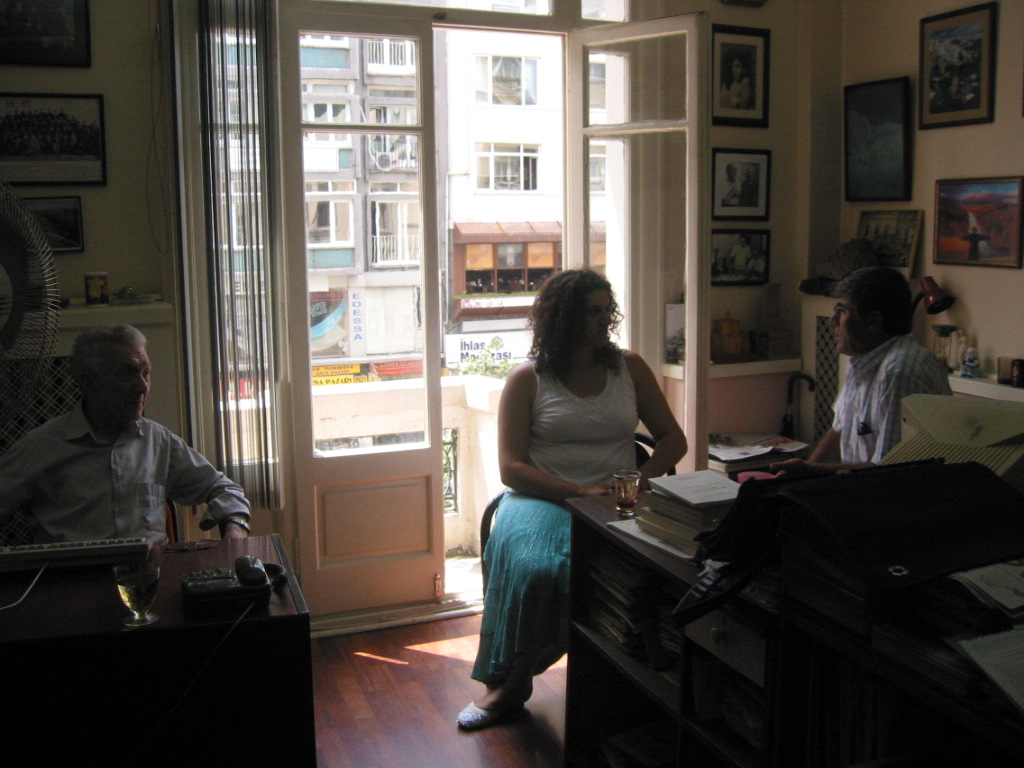
In the summer of 05 I was in Istanbul.... learning Turkish and getting to know the Armenian community who lives there. there are numerous stories I can tell about my experiences there, the following story is one that I can never forget and that i remember everyday.... I have yet to report it to a media source, even though there have been many requests to print it, but it is personal and it evokes great emotion in me, but today I want to share this story with our forum members. living in Istanbul, was difficult, being a 21 year old Armenian lady.... with all the history... which became a very difficult reality to live with everyday.. .this was something I chose to do and wanted to do...I had many questions...my existence there serves a great purpose, which I will one day share. So here it goes.. I had decided that I wanted to meet Hrant Dink, way before I got there... so about 2 weeks into my "trip" I randomly showed up in front of the Agos building in the afternoon after my language class... All of the sudden I see him stepping out of this huge beautiful door, with one of his associates. So I introduce myself and say I really need to talk to you.... keep in mind he had no clue who I was, besides the fact that i wrote to him a few years back, yet i do not believe he made the connection, or at least he did not show it.... He asked the person he was with to go on his way and told him that he would meet him a little later and he invited us up. When i think about it now I keep telling myself how incredible he was that he just changed his plans, for this girl who was asking way too many questions that he did not even know.... so he welcomed me to the office, showed me around, introduced me to everyone, then he sat down in his office, which i found to be beautiful because of what was on the walls (picture of komitas, nurs, duduk, an old image of all our Armenian intellectuals together in one room which is almost impossible to find now, it was all Armenian). In any other circumstance i would not be as surprised or amazed, actually it was very typical for an Armenian, all our homes are like that, well not all but majority, but after living in Istanbul where the Armenian Diaspora is facing a very harsh reality ( and not just Armenians, many other minorities as well) that newspaper office represented hope for me. So he asked me to sit and said "what is it you want to know," and I asked away... for over an hour... he was so patient and took great effort to make sure i got every question answered. I was so astonished, one day i will write about our conversation, but what i want to share today is not that conversation, it is about what type of person he was. He canceled all his plans to share that moment with a complete stranger, and keep in mind he was an extremely busy man. Also, this was the exact time that he had the court cases against him, which he explained to me in full detail... And for anyone who has read the last piece he wrote, which bbc and AGOS published later...he wrote, "I may see myself as frightened as a pigeon, but I know that in this country people do not touch pigeons. Pigeons can live in cities, even in crowds. A little scared perhaps, but free." he really believed that! this small story is just a part of my experience, yet i believe it fully entails who he was and the memory he instills in our hearts. For me, he will always be, he continues to live on. ~ armo

-
He uses nur in the majority of his works.... and his works are BEAUTiFul
-
first and foremost thank you all for your replies. Its interesting to see your perspectives and the subtopics that were raised. I agree with the majority that was discussed, problems for wages (for the majority of the Armenian Schools, minus one that I know of very well and know how they take care of their teachers), the system, the concerns... I want to clarify my question a little by being more specific.. lets say person x is a teacher at a Armenian private school. x teaches 9-12, and as most private schools x gets to really know the students because x teaches them for minimum of 2-3 years. Lets say x teaches Armenian or even history per say. x always shows x's enthusiasm, love and pride for the Armenian culture and history.... my question is to what extent can x influence these kids to stay Armenian (this is not counting outside influence and family). The way im thinking of it is ... did you ever have this teacher that loved something so much and was all into it which inspired you to think differently? essentially the question is how important is the teaching of "Armenianness" (no such word but im gonna use it) passively (meaning its not in the lesson plan) at a secondary school level to teenagers getting ready for college? To what extent do teachers make a difference? please let me know if any of this is not clear.
-
to what extent do you guys believe teachers in armenian schools can help our young generations maintain their armenian identity and pride? Do they play a role at all?
-
how about oryort by tata simonyan.... it starts by saying du jermak, hakit jermak, aynpes makur u jing oryort, yete khntrem dzerket jermak indz che merjes sirun oryort...... kez hamar yerkem sirunes kez hamar yeraz darnam... its a beautiful song. hope its helpful
-
Mosjan forget "punked" and "yerokoyan coctail," I think you should have you own show! so Istanbul ayy... will it be at Rumeli Hisar...hehehe
-
Ameninch ira jamanake uni , dard mi arek