OK, here is the remaining half - almost 6 months after I said it would arrive!
(Which answers the "Have you considered writing a book?" question - it would take me too long!)
The Lost City of Handut
Part Two
The first problem was to get from Kagizman to the closest village to the castle. On maps, that seemed to be a settlement called Kuloglu, which lay beside the Erzurum road. This should mean plenty of traffic, but it was a Sunday so we knew that there would not be as many buses as usual. We were told that the bus from Igdir to Erzurum was supposed to arrive at Kagizman around 9.30am. However, even if it was on time, and if there were free seats, it might get us to Kuloglu too late in the morning since we may need to do a lot of walking to reach Handut. A taxi seemed to be the best option, regardless of the extra cost.
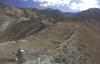
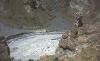
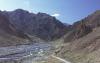
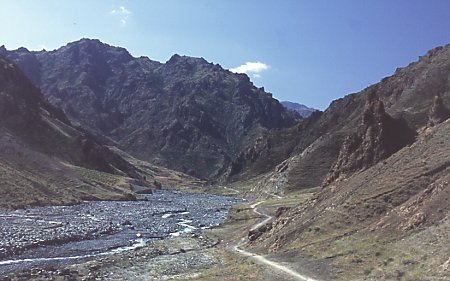
After breakfast of soup (the only food served in the only restaurant that was open) we left at about 8.30. Half an hour later we had turned off the main road and were driving through the village. The drive-able road ended just outside the village. A wide valley stretched invitingly beyond us, running up into the hills. Filling about a third of its floor was a rubble-strewn riverbed through which meandered the Kaput River, a tumbling and fast flowing stream. On the horizon, far ahead, were jagged mountain peaks. Closer in there seemed to be only ridge after ridge of bare hills.
As we were getting out of the taxi an elderly man approached us. We decide to ask him some questions. "Is there a castle around here?" "Yes there is". "And what’s it called?" "Kaput". "And what about another place, a ruined city?" "Yes – that’s called Handut." "But", he continued, "it is too far to walk there, you will need mules. It is too rough, there are no paths, you have to ford the river about 12 times. You won’t find the castle because it’s so well hidden you will walk right past it. What if there is someone there who would do you harm. You should return to the village, arrange for guides, and for mules to ride on". He went on and on like this for about 10 minutes. It was getting us nowhere and I was becoming worried that his "we should" would soon become "we must". The castle, I guessed, was at most three hours away - so we had plenty of time to get there. However, a visit back into the village would, I was certain, just result in us being refused permission to proceed. "Let's just walk away" I suggested, "before his reasons for us not going become even more insistent!" We did that, swiftly leaving him and his village behind.
We walked briskly up the valley, anxious to get as far away as quickly as possible and happy to be out in the countryside for the first time in many days. The morning air was cool and refreshing. The track we were following ran along the right side of the valley and just above the riverbed. It was easy going, wide, and fairly level. Suddenly, after about an hour’s walking, the track stopped: it had been entirely washed away by the river. By then the valley had narrowed and become gorge-like. The boulder-strewn riverbed filled its entire floor, with the meandering river rushing from one side to the other.
It was time for us to start fording the river. The water was icy cold, but it was repeatedly having to take off of shoes and socks - and then waiting for our feet to dry before putting them back on again - that was the annoying bit! We had crossed the river about four times when I noticed a rider was approaching us from behind. He introduced himself as one of Kuloglu's 'village guards' and said that he had been told by the village headman to escort us to the castle. It could have been worse - he could have come to escort us back to the village. I’ve forgotten his name, so I’ll just refer to him as 'our guard'. Thorny, lucky girl, got invited to ride on the horse! Considering how rough the route was, I thought at first that this wasn’t much of a favour! But it was a much quicker, and drier, way to travel. And the guard wore sandals so, for him, fording the river was quick. He and Thorny quickly got further and further ahead, and I had to rush and stumble over the rocks just to keep them in sight.
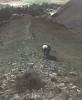
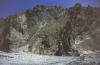
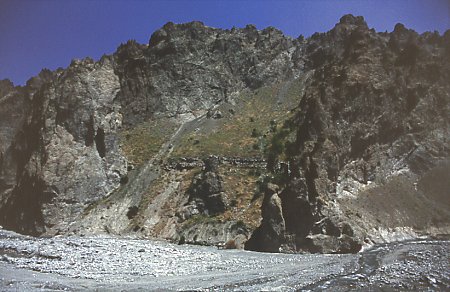
Suddenly, I found that I was opposite the castle! To be honest, the sight of it was a bit of an anti-climax. As a castle it seemed to be little more than a single wall. Picture a u-shaped ridge of sheer sided rock, with the top of the "u" resting against the edge of the riverbed and the inside of the "u" filled with earth and gravel at a slope of about 60 degrees down to the river. And picture a wall crossing between each arm of that "u", about 1/3rd of the way up the slope. That sums up Kaput Kale. The single wall gave me another interpretation for the castle's name. Kaput is the Turkish word for cloak, and the wall was like a screen or cloak that crossed between the two ridges.
There was nothing in the wall that looked like an entrance, nor was there any path up to it. There was a gap in the right hand arm of the u-shaped ridge. Getting there involved fording the river once more, and then scrambling up a nearly vertical rock face, but this did seem to be the actual original entrance to the castle. Our guard protested against taking that route, saying that it would be easier to climb up to the wall, but I wanted to arrive by the proper entrance. Fortunately the rock was rough and easy to grip, so the climb up wasn’t too difficult. The gap was barred by the remains of an arch, behind which was a short entrance corridor, and then a narrow passage between the vertical rock face and the castle wall. From the inside the wall seemed more like an embankment: loose rubble and soil from the slopes above overflowed the top of the wall, and there was a danger of us slipping too close to the edge and falling over.
As a castle it was a strange structure – there was nowhere behind the wall for any accommodation, unless it had been built on the actual walls. I scrambled higher up the slope, right up to the innermost end of the "U", but could see no trace of any buildings, or of any other walls. The whole slope was composed of loose gravel that would move underfoot, so possibly something lay buried underneath
Why was a castle build in this remote location? A key to answering that question might lie on a small pinnacle of rock that stood in front of the wall. On it was built what looked like a tower, but which was probably the end of a wall that had once protruded from the main wall, rather like a finger. From there the occupants of the castle would have had a clear view up and down the valley. The castle was probably built to control a trade route that ran along the valley floor.
There was nothing else to see, so we decided to go back down to the river. Thorny decided to go down by a different route, through a gap in the wall and then down the slope. She slid most of the way on her bottom! I decided on stick with the original way, but it was much harder climbing down than climbing up! All was fine until I got to the river, In the opposite direction I had had enough of a run at it to jump clear across, but since the cliff face ran straight into the river, there was no space for that on the way back. I should have just waded across – but I decided to jump it anyway. I did reach the other side, but the rock I landed on moved and I tumbled off it, banging my left knee heavily against its surface and then falling back into the river. I scrambled out, soaked from my shoulders down, trembling as much from the cold as the shock, and sat on a more stable boulder to recover and dry off a bit.
It turned out that Thorny had also suffered a mishap in her descent: she had slipped and then slid most of the way down on her bottom!
We retired to the shade of a cliff at the base of the castle, and I lay my shoes out in the sun to try and dry them a bit. Looking further up the valley I noticed that conifers were starting to appear, and they were thickly spread over the further away slopes. There was no path, only the same boulder strewn riverbed. I asked Thorny to ask our guard if there was anything else of interest nearby. He said that further up the valley, about 2 hours away, there was a church. This agreed with what the 1879 archaeological report had said. And far beyond that, at the very end of the valley, he said that there was another castle, called "Mader". He also pointed out a little rocky pinnacle that lay just a little bit ahead – someone had, he said, found treasure there. "And what about the ruined city, the place that is called Handut?" "Oh, that is way back down the valley, near the village!" I was surprised that I could have walked past an entire city (even if it was in ruins) without noticing anything of it!
Our guard said now that he wanted to return to the village, and insisted that we had to return with him. I was feeling rather grumpy. I was annoyed that there had been so little to see in the castle, annoyed about getting wet, annoyed about hurting my hurt knee and facing the prospect of a difficult walk back because of it. But mostly I was annoyed because I wanted to spend some time just sitting around, enjoying the landscape, and the solitude of the place, and being in Thorny’s company. It was still only 1pm, we had brought food with us for lunch, had plenty of water, and had time to spare.
I announced that I wasn’t moving until my knee felt better and until my shoes had dried off a bit – I was hoping that our guard would just decide to return by himself. But it was quickly clear that his orders precluded him doing that, so, after sharing some of our food with him, we had to leave.
Thorny suggested that, because of my knee, I rode the horse on the way back. Maybe that wasn’t quite the selfless act it appeared to be – after her slide down from the castle, poor Thorny’s bottom might have been too tender for horse riding!
The saddle on the horse was not like a proper saddle. It was a contraption made of wood that looked like a sort of upside-down cradle, with a blanket laid between the horse and the saddle and another blanket between the saddle and the rider. However thick the blankets, they could never have been thick enough for either horse or rider to feel comfortable! There were no stirrups, and the whole saddle had an alarming habit of slipping from side to side when the horse made sudden movements.
The horse seemed to know the way – it must have travelled this same route many times – and also seemed to want to get home as quickly as it could! Soon Thorny and the guard were lagging far behind, and pulling at the horse’s reigns only made it stop for a few seconds. Luckily, shortly after leaving the castle a group of riders joined us and Thorny got another horse to ride upon. They were coming down the valley, probably after taking supplies to summer encampments up in the mountains.
As we began to get closer to the village I asked again about Handut. "Yes, it is up there" our guard replied, pointing vaguely at a ridge overlooking the opposite side of the valley. I scanned its slopes as best as I could from horseback, but could see nothing.
"Did I still want to go there?" he asked. I did, but Thorny didn’t. She wanted to return to Kuloglu with the rest of the riders. Perhaps she had been discouraged by the insignificance of Kaput – though I had sensed that her interest in things in general had been waning. For a moment her apathy caught me too and I considered letting Handut go. But then I remembered for how many years I had wondered about Handut. When thinking of it, I had pictured an expansive site, located far up a wide valley, with the ruins of city walls and houses and chapels and other buildings filling the valley floor, and with Kaput castle overlooking it and acting like a sort of citadel. That obviously wasn’t what it was going to be like – but, after coming so far, I had to know what Handut actually was. I didn’t have the time to try and persuade Thorny to change her decision: her horse had passed by mine and was already too far ahead.
Our guard also had to go with me. We left the path, forded the river, crossed over some fields and then began to ride up the sides of the valley. I got off the horse as things got steeper and steeper, The slope were just bare gravel with the occasional protruding bits of rock that would crumble into razor-sharp fragments if held onto. Rain had cut steep gullies into it. This was hard going for humans, but was a place no horse was ever meant to go! As the guard pulled and pulled at its reigns I was afraid it might stumble and roll back down onto me, so I lagged deliberately behind.
As we scrambled higher and higher, leaving the stream and the track far below, there seemed to be no trace of human activity in this landscape. But then, still quite far away, I noticed a slope strewn with rubble – rubble that must have fallen from something built on the summit of the ridge.
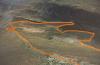
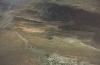
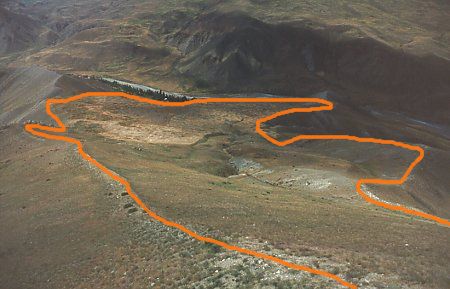
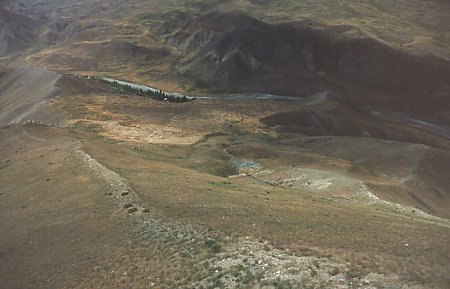
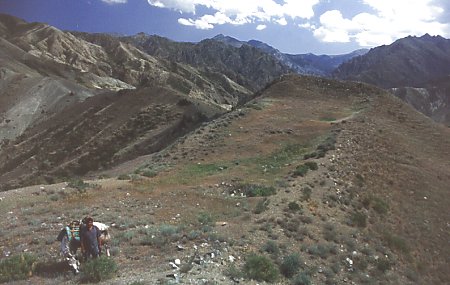
Eventually, completely exhausted and with my knee starting to throb, I reached the top. I found myself standing on the top of a ridge that separated the Kaput valley from a smaller valley further to the east. The rubble was from a wall that had once barred access to one end of that ridge. The wall was just a pile of rubble and nothing was identifiable, I was worried that was all there was to see! Once on top of it I realised that it formed one end of a long, rectangular enclosure that covered the whole top of the ridge. It was about 25 meters wide and perhaps 250 meters long, and it seemed to be a very simple castle. The walls were only visible as low mounds, and inside the rectangle there were the faintest outlines of some buildings. I took a few pictures, using the horse to give a sense of scale. At the far end of the rectangle there was a rocky outcrop. The foundations of another wall ran up its side, looking from a distance rather like a staircase. We climbed up, leaving the horse to graze on the grass that grew within the enclosure. The view from the top was magnificent. To the east and the west: all along the main valley. To the south: far up the Kaput valley. To the north - a panoramic view of the edge of the Kars plateau. The illusion of the barrenness of the main valley vanished. All along its length there were patches of green around settlements at the base of every side valley. The gentle slope up to the Kars plateau had its surface cut with numerous green threads, the route of little streams that, early in the season, would have led to the whole hillside being covered in grass.
But what really caught my attention was the line of a wall that descended from the castle, down a steep slope, to encircle a large area of flat ground far below. I followed this wall’s route with my eye, and with an increasing excitement as the area the wall encircled got bigger, and bigger, and bigger. This wall enclosed a city-sized area – no doubt about it – big enough for a settlement of at least 10,000 inhabitants. About 1/3rd of the site seemed to be just bare ground, especially the slopes approaching the castle. Another third of it, on the lowest areas, was now cultivated – there were piles of cut hay spread around piles of boulders and rocks. The remainder of the site was not cultivated, and had the same unevenness to its surface that can be seen at Ani – a sure sign of structures hidden underneath the soil. We descended from the castle, (or rather the citadel - as I now realised that is what it was), following the line of the wall. The wall was about a meter wide. Apart from in the citadel, nowhere was it standing above one course high. Either the city walls had never been completed, or what I was seeing was the stone foundation of a vanished mud-brick wall. On the route down from the citadel we passed a small opening in the wall that may have been a postern gate.
Walking over the area of uneven ground, I saw that it clearly had the outlines of rectangular structures. I would have liked the time investigate further, if only to follow the entire circuit of the walls and check if it was actually all one wall. But I knew Thorny was waiting for me in the village and, also, I didn’t want to show too much curiosity.
A modern track came up from the village and ran through a gap in the city wall. This gap was probably on the location of the main city gate. All around that spot there were fragments of clay pottery. I did not see any ceramics – which could point to an early date for the site. I picked up one distinctive looking potsherd. It was the rim of a large, wide brimmed container. The rim was decorated with a series of triangles, produced by pressing a triangular stamp into the clay while still wet.
On our way back we were waylaid in an apricot orchard, for tea and apricots. Even more tea, and bread, and cheese, and boiled eggs awaited me in the garden of the house belonging to the head of the village guards. But more satisfying was my realisation that a gap in Armenia's history was filled in: Handut is almost certainly the site of Artagers.