onjig
-
Posts
1,644 -
Joined
-
Last visited
-
Days Won
134
Content Type
Profiles
Forums
Events
Gallery
Everything posted by onjig
-
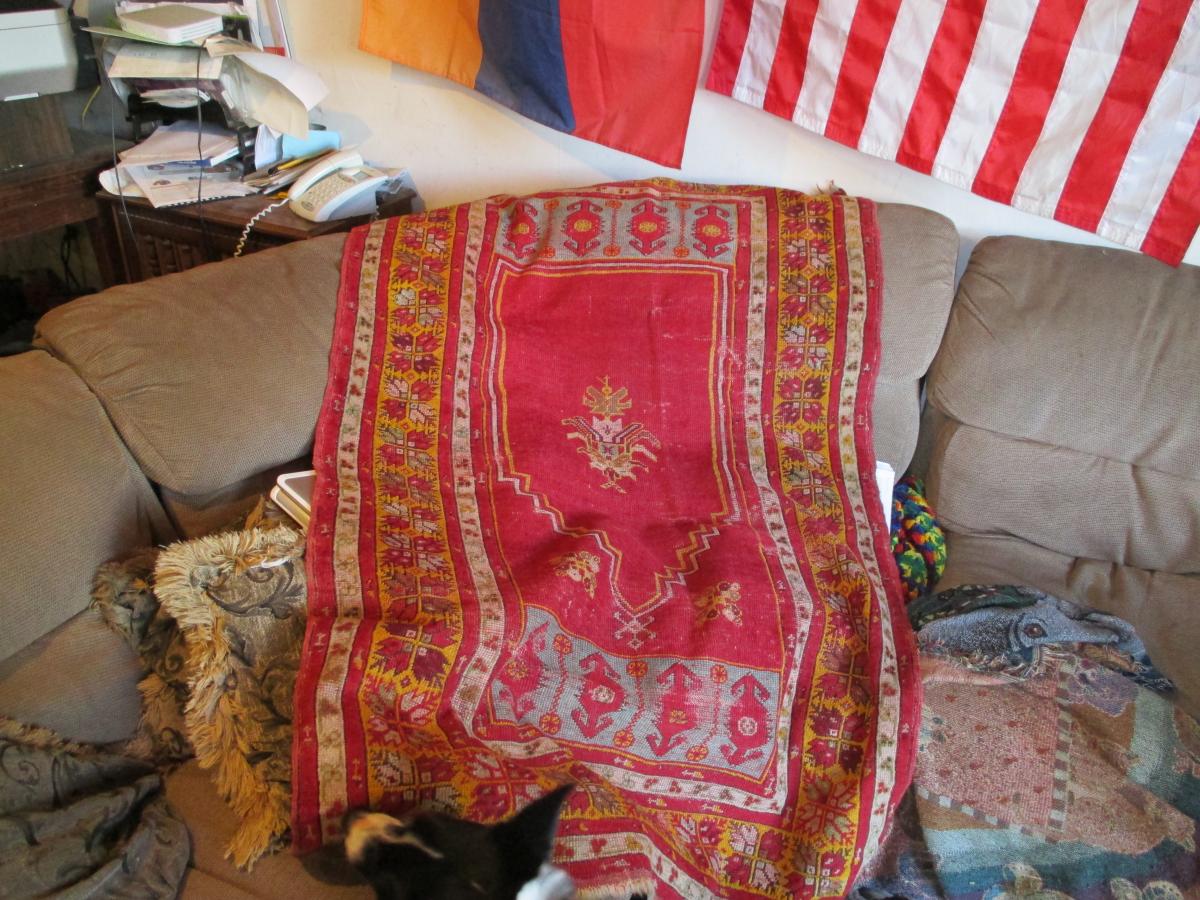
I have here two Armenian carpets, brought to the US in the Late 1800s by Medz Mayr ou Hayr. Here is a picture of one, the two are almost identical. I just noticed it is upside down.
-
I have here two Armenian carpets, brought to the US in the Late 1800s by medz Mayr ou Hayr. Here is a picture of one, the two are almost identical. I just noticed, it is upside down. They were never on the floor, but were used to cover the beds. Inside the gold perimeter are khatcher in the pattern.
-
I have here two Armenian carpets, brought to the US in the Late 1800s by Medz Mayr ou Hayr. Here is a picture of one, the two are almost identical.
-

Diaspora Philanthropists George Najarian Disillusioned With Armenia
onjig replied to MosJan's topic in Republic of Armenia
Is there anything more on this case? Do the Najarians have their land back in their control? -
A book about the Armenian Genocide permitted in that country would be the thinnest book in the world, as thin as a book of Jurkish honesty.
-
I remember the gathering of funds to buy the area with the Cross. I remember also receiving{ I guess we all got them] a letter from a tuirk organization telling me I should contact certain officials to stop the purchase.
-
Not sure what you are saying. I know there are atheist Hye, and those who are very into politics, but I don't believe there is an Armenian alive today, who worship a stone, a fish or a serpent.
-
A Medical Mission Trip That Taught Us So Much
onjig replied to Yervant1's topic in Science and Technology
That was very good to hear, to read. Thankyou for posting. It is fulfilling when one of us can give to, help Armenians here, and much more so in Armenia. I feel, I can hear in his writing a satisfaction in being able to work with and give to his people. -
Dear Arpa, You must get hold of yourself, waving your arms and screaming, slamming doors, with that vein standing out on your forehead. You will bust a puffer valve. You must keep things in perspective. Dear Arpa you are an important part of an Armenian Gathering. Butttttttt, you are not the richest, tallest, smartest or most Armenian. There is no need to agree with other Armenians.........Nor is there cause to edit, criticize or curse them. Dear Arpa please remember: Not one of us is THE ARMENIAN..........each is only an Armenian. I choose to like you. You serve an important role in this, Important Gathering. God bless and keep you.
-
Would it be safe to have an open border to our western land?
-
Lord Byron rowed out to the island daily, for 7 yearsm to study and learn to speak Armenian. He fought the Turk in the Greek war for freedom. It was while preparing an attack to be launched from the sea, he planned and hope to free Armenia, he became ill from the cold and rain and died of that illness at 36 of age.
-
No, she did nothing, and nothing was done. She too in innocent. she too, lives on our land, in our house, gained by the death of the owners. There was a war. Everything done during a war is OK and does not have to be admitted, explained or undone. Children of the Sick Man of Europe eat figs from the tree or the man, woman and child he killed. Their hands are clean. They did nothing wrong. As she says, she is the daughter of the new jurkish republic, she grew up on the knee of her ottoman grandfather's knee.
-
Yes, her hand are clean, she too is innocent of the murder, and much time has passed, and did it really happen? And, And, !!!!!!!!!!!!!!!!!!!!!!!! These are the same Jurks that applied to the Insurance Companies to collect on Life Insurance Policies paid for by the Armenians themselfs. And the Insurance Companies answered "How do we know they are dead?" And The Jurkish governsmut answering "We Can assure you, "They are Dead!" So, she is clean, feels no guilt, she also is innocent. But, she lives on our land, prophets from what she, no not her, They the others have stolen from those they "Can assure are dead" They no longer live in tents, robbing people in the east. They, she, live in our house, saying we, our parents, families did not die of their wounds or forbidden to drink their own water, died of thirst, or, or, or all the other unwanted deaths they gave.
-
I watched something that looked like a talk show, in which a person identifying himself as ara manukgian showed a video of the Verhapar's election. In this video is pointed out a person as Arch Bishop Hovnan Derderian handing Verhapar a note. THIS WAS NOT Arch Bishop Hovnan Derderian! in the video. He invited/demanded the Arch Bishop call him to explain. This talk show host also was trying to say the KGB used force and threats to install Verhapar. I think he has no right to imply this type of thing. { I know a person who was there, I will tell him of this.} In the video Verhapar announced the tragic event, the murder of members of the government, it was implied Verhapar was not surprised and was clearly not sorry in his expression. This is clearly opposite to the truth, Verhapar had the look of shock at that time. { Later in the show it was implied Verhapar had prior knowledge and was part of a plot to have these people murdered.} It is very sad to see an Armenian acting worse toward our Holy Church than in done in American politics.
-
We attended Holy Badarak in Sidney, most if not all were Eastern. They went to and from the Berma facing the Altar, without shoes. Revere the Lord!
-
Shad avor.

-
http://www.ancient-battles.com/catw/armenia.htm
-
Armenian Army Before Christ Leave a commentAZAT KARDAKA : The Armenian infantry was not of a nomad culture. Great cities were established in a mountaineous land, providing a mix of infantry and heavy cavalry. This infantry was partially inspired by the ancient model of the Persian Empire, but Armenian Sovereign soon admired the new Hellenistic model of the conquerors and created Hellenized eastern infantry such as the kentronakan and the nakahararakan (originally dismounted bodyguards of the royal palace). These were foot soldiers, a battleline unit, using the phalanx formation. In 300 BC Armenia was a former satrapy of the Persian Empire, now an Alexandrian satrapy, under the rule of Neoptolemos, and in 301 bc, an independant kingdom under the old Orontid dynasty, and Orontes II. It was under the sphere of influence of the Seleucid empire, and a Hellenized court. This infantry was a cross between the Persian kardaka, hoplite-like heavy bodyguards, and traditionnal greek hoplites. Their clothes were those of the kardaka, and their greek-style linen armor was reinforced with bronze scales. They bear also a short sword and a 75 cm to 1-meter wide aspis, made with wood and reinforced with bronze. They also bear an Urartian cone helmet. In a battle, they usually stay with the king but could fight alongside the spearmen and were more agile than most. DISMOUNTED NAKAHAR : This elite infantry was in fact not a regular one, composed of dismounted cataphract nobles, to act as a heavy infantry when needed on rough terrain, as an assault support or an elite assault infantry. Although slow and not particularly agile, they were highly protected and fought with heavy mace and javelins. AZAKU MARDIG (late romanized heavy infantry) : Between 180 and 150 BC, the Romans victories against the Hellenic phalanx had a tremendous impact on the warfare doctrine in the east and southern Hellenic kingdoms. Under Tigranes II, dismounted nobles or wealthy warriors were chosen to form specially trained units, with a strong legionary influence. Although having some Hellenistic equipment such as the thureos shield, greaves, scaled linothorax, several javelins instead of heavy pila, and a long eastern sword instead of a gladius, they were used in small sized homogeneous units for better tactical flexibiliy. As an elite, they were few, but by far the best foot infantry of Tigranes II which discarded some of his former phalanx units. These units were part of the Armenian “Imperial” new army that conquered roughly the western part of the former Persian Empire. During his reign, Tigranes saw himself as the successor of the Hellenist culture after Pontus failed to defeat the Romans. Although a match for the Roman legions, these azat warriors were only a small part of the whole Armenian infantry, mostly still made up of old-style light spearmen and mountaineer axemen and archers. They saw some success against Lucullus in 68 bc, they failed eventually to prevent the surrender while facing the Pompeian armies. HAI NIZAKAMARTIK (armenian thureophoroi) : Elite skirmish free men (azat), with heavier equipment than the usual javelinmen, they could stand their ground against all kind of infantry. Historically, this was a relatively late unit, created under Hellenic influence. They were lighter than the later legions and even but highly skilled. GUND I PATLA (Local tribesmen levy peltasts) : local caucasian javelinmen, raised from remote villages and fought with light equipment. They were better for guerrilla warfare. THANVAR HAYASDAN (levy tribesmen archers) : Armenian free archers, they used their light composite bow with great efficiency, not with spectacular range but quick rate of fire. THANVAR AZADAN (Elite archers) ; Certainly amongst the best archers in Asia, they stood their ground fiercly, with powerful long-range composite bows and specially-shaped arrows. They were also highly skilled in longsword close-range battle. SHIVATIR (Mounted archers) : The backbone of the light cavalry, these levied horsemen were famous for their skills, speed, rate of fire, and accuracy. They were a nightmare for heavy troops on march, lightely protected infantrymen, and were used to harass enemy lines. At close fight they fought with light axes, daggers or short swords. SKUDAN SHIVATIR (Scythian horse archers) : Although the Armenians never expand north beyond the Caucasian barrier, many scythian fled to avoid slavery or the constant threat of the Sarmatians. From Pontus, many scythian horse-archers traveled the black sea to serve as mercenaries, due to their ancient and widespread fame as horse-archers. The late Tigranes Empire, controlling the Silk Road and many Black Sea eastern ports, was rich and could enlist mercenaries en masse, including many Scythian horse-archers. ASPET HETSELAZOR : These were lesser noble cavalry, petty nobles earning small properties, lightly but well protected, and using short kontos. They formed the bigger part of the lancer cavalry, mounted on medium sized horses that were known for their speed. Perfect to counter most cavalry units, they were good at protecting the flanks and chasing off light infantry or added their weight to the charge of the nobles. ZRAHAKIR NETADZIK : These noble horse archers were well equipped and highly skilled, trained as horsemen for war and hunting from their youth. Disciplined, sturdy and hardened, they formed the “long arm” of the fast-moving Armenian cavalry. Horses were powerful niseans, but only partial cataphracts in order to be faster. After a rain of arrows, these nobles fought melee with heavy maces, swords, and kontos that their retinue carried. KAPPATUKA AZAT : This famous heavy cavalry from near Cappadocia were part of the gigantic Armenian army during the reign of Tigranes II, after the fall of Pontus. They were a breed that was a cross between the local and nisean breeds, producing strong and tall mounts. Famous in the Persian army, they retained their fame and quality until the fall of Pontus and Armenia under Roman sphere, most of them recruited to form the first clibinarii units to fight the Parthians and Sassanians. NAKAHARARAKAN ASPET (Early bodyguard cavalry) : These high nobles were retained in the royal guard as cataphract lancers. They were kept in reserve and launched when necessary, delivering an unexpected shock to the enemy forces. After the blow of their heavy cladded nisean horses and the long kontos lances, melee combat was common using maces and longswords. If the first blow was not sufficient to disrupt the enemy line, lighter cavalry then charged to turn the tide of battle. HYE SPARAPET (Late bodyguard royal cataphracts) : These heavy cavalry were modelled partly on the heavy Parthian cavalry. These were nobles of noble lineage which formed a very powerful and impressive unit of cataphracts with only one goal : Crushing enemy infantry lines, including the heaviest and well-armed. They were slow, but their tremendous charge was like a hammerhead. After the shock of their long and heavy lances, they fought in the melee with heavy maces, ready to crush helmets and shields. source:
-
It would be good to record them, at least for the family, myrig told me to. I was trying to point out that Armenians in the central valley of california had some things to deal with. Saroyan grew up there at lived it. Thankyou hagopn, for your appeciation and understanding.
-
Arpa! I have read this: Khent, It, tragedy! I wish I hadn't read it! No, I'm glad. I hate having read it! How many years we suffered that. Why did you post that, without warning?
-
I think Saroyan was a good man, an Armenian, who worked hard and became well known, good for him. He was Armenian in his heart and well liked by Armenian people. Armenians were proud of him and proud to hear him mentioned. In early California, Armenians were not well treated by many, jealous of their success. Signs, big signs, Foster and kliser size were set up on roads leading into Fresno, Visalia, and several cities in California. These signs read things like: Armenians are not wanted here! Armenians are not white." I over heard the telling of the boys, Myrig had ten brothers, together pulling down a sign and dragging it out into open country. " Burned up the motor in Lawyer keck's [ Kecklician] Cadillac" Why would that happen? I asked. "These were big signs, roads weren't smooth like now." This was Uncle Joe [Joseph Adalian] speaking. "Folks had a buggy and we used wagons to go into town, horses to work in our vineyards." " Not many people had cars." Uncle Joe, moved to Los Angles during the depression, became a mechanic and opened Southwest Garage, was drafted into the army at the age of 47, given a commission as Sergent and served in North Africa during WW II, keeping the tank, trucks and jeeps moving. In Africa Uncle met Richard [Dicran] an Armenian from back east. One day together, Richard driving the jeep in Algiers North Africa, there was a crash, Uncle received a broken leg and was shipped home on furlough for three weeks, before returning to war. He, Uncle Joe lived with the folks, after moving to LA area until his time to walk with the Lord. Re: Saroyan. He like you and I, wrote things, thought things and said things at twenty that we might say and write differently today. I am proud of him, have a library of his works, he is one of us.
-
Mirig was born Maryam Marget Adalian, in Yetem, California in the year 1900 on the Adalian ranch. Her friend Lucy Saroyan's brother wrote short stories and articles. She was happy to know people liked his work even non Armenians. While I never knew the family, I saw, as years passed, there were fewer people who didn't recognize his name. That saying attributed to him bothered me, knowing we were almost erased and they are not satisfied yet.
-
This person refers to Source. This may come from the pages of Anor vor kirk. [i like the fact the Georgian flag has a kahtch too bad our flag doesn't have a kahtch on the tri color, [i have a lapel pen that has just that.] I think this thing is like many others, implying the Armenians are just visiting or just arrived recently to every place they are now. Even the Greeks, and I like them very much, wanted us to be Greeks and be part of the Greek church, saying a Greek Bishop ordained Krikor. The Roman wanted us to use Latin in the Holy Badarak. This thing tries to make it sound like we were cousins but Javakhk has been Georgian for a long time, so be quiet so the Murks can build a rail road around the postage stamp part, we inhabit, of former Greater Armenia. I read something, written by an asurjurk, to the effect all the Armenians in what is now called Hyastan are the decedents of twelve families allowed to settle there less than a hundred years ago by the azur%%^$$%. You expect to hear those trying to rewrite history, to put us anywhere but where we came from or leave us out completely. You expect it but never get use to it!
-
Christian Armies retake Constantinole http://www.levantineheritage.com/troops.htm Why on earth did they leave?
-
http://pjmedia.com/tatler/2011/05/31/turkey-celebrates-558-years-of-illegal-occupation-of-constantinople/