lizchater
-
Posts
44 -
Joined
-
Last visited
Content Type
Profiles
Forums
Events
Gallery
Everything posted by lizchater
-
Thank you once again for sharing this latest article on Armenian heritage in Bangladesh. For anyone interested (and if you've got the reading stamina) you can see the full unedited version of this story on the website. http://armenianchurchbangladesh.com/spotlight-on-the-community/stephen-family/
-
Thank you once again for sharing this article.
-
Thank you so much for sharing this article and your kind words regarding my research efforts. If anyone has Armenian connections to the community in Bangladesh, please do get in touch with me. It would be good to include as many people and their stories as possible in the Bangladesh Armenian Heritage Project.
-
Moses Here is the google maps link to the Hong Kong Cemetery http://maps.google.co.uk/maps?hl=en&q=hong+kong+cemetery&rlz=1R2GGHP_en-GBGB414&bav=on.2,or.r_gc.r_pw.r_qf.,cf.osb&biw=1097&bih=561&wrapid=tlif133305058139910&um=1&ie=UTF-8&ei=5rx0T7S_NuGx0AXcmYkZ&sa=X&oi=mode_link&ct=mode&cd=3&ved=0CBAQ_AUoAg There is no Armenian Church in Hong Kong, but there is a small community. Email me and I'll give you a contact name. Liz
-
Dear Louise thank you for your reply. Yes, there are many Armenian graves still in India. Most of the old graves are in Kolkata and the surrounding area, but Armenian graves can still be seen in Chennai (Madras), Mumbai (Bombay), Saidabad, Surat, Chinsurah, Agra and other smaller towns and cities in India. I have looked on your forum to see where you have put the information but I cannot find it, so I am replying here. best wishes Liz Chater
-
You're welcome
-
Apologies. Apparently the link did not post on my original message. Hopefully this link will take you to the book. http://www.blurb.com/my/book/detail/2277738 regards Liz
-
-
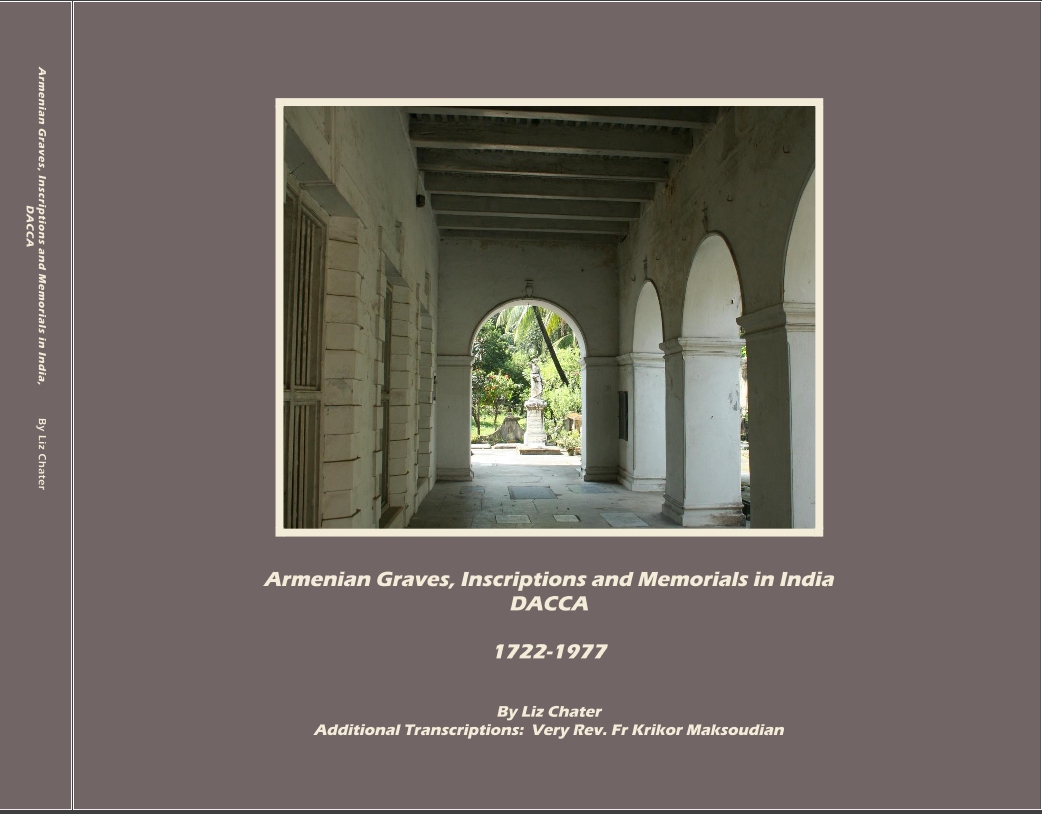
Dear viewers, I hope it is not too much of a liberty, but since it has been a forum topic in the past, I thought you might be interested to know that I have now completed my book which records all the Armenian Graves and Inscriptions in Dhaka in Bangladesh. “Armenian Graves, Inscriptions and Memorials in India – DACCA – 1722-1977”. It contains in excess of 160 full colour photographs of all the remaining graves at the Armenian Church Dhaka (Dacca, previously in Bengal but now in Bangladesh). In addition, I have included over 25 individual family tree charts that relate directly to those Armenians buried in Dhaka. These charts have been drawn up from my own research of the Armenian community’s existence there between the 18th and 20th centuries. I have also uniquely cross-referenced the grave inscriptions with the original Armenian Church death register entries and where possible, I have also included important factual information from those registers. All transcriptions and register entries that are written in Armenian have been expertly translated into English, the majority of which have been completed by the very Reverend Fr. Krikor Maksoudian, to further help the Armenian family history researchers around the world who may have a South East Asia genealogy connection. The book is published by Chater Genealogy Publishing through a self-publishing print-on-demand online website www.blurb.com. The direct link to purchase the book is: http://www.blurb.com/bookstore/detail/2277738 Please note that due to the print-on-demand conditions of the website, I am not able to take orders for the book directly. To obtain a copy please use the above direct link.
-
Dear Arpa, Thank you for your kind words. In this instance Chater is the anglicsed version of the Armenian name "Astvatsatoorian". In colonial India official records indicate it was shortened to Satoor, then Chatoor then Chater, so there is no French in this particular Chater, but I have met Chater's who are of French decendency. Sadly, I do not speak Hindi, but the sentiment is greatly appreciated Arpa. best wishes Liz
-
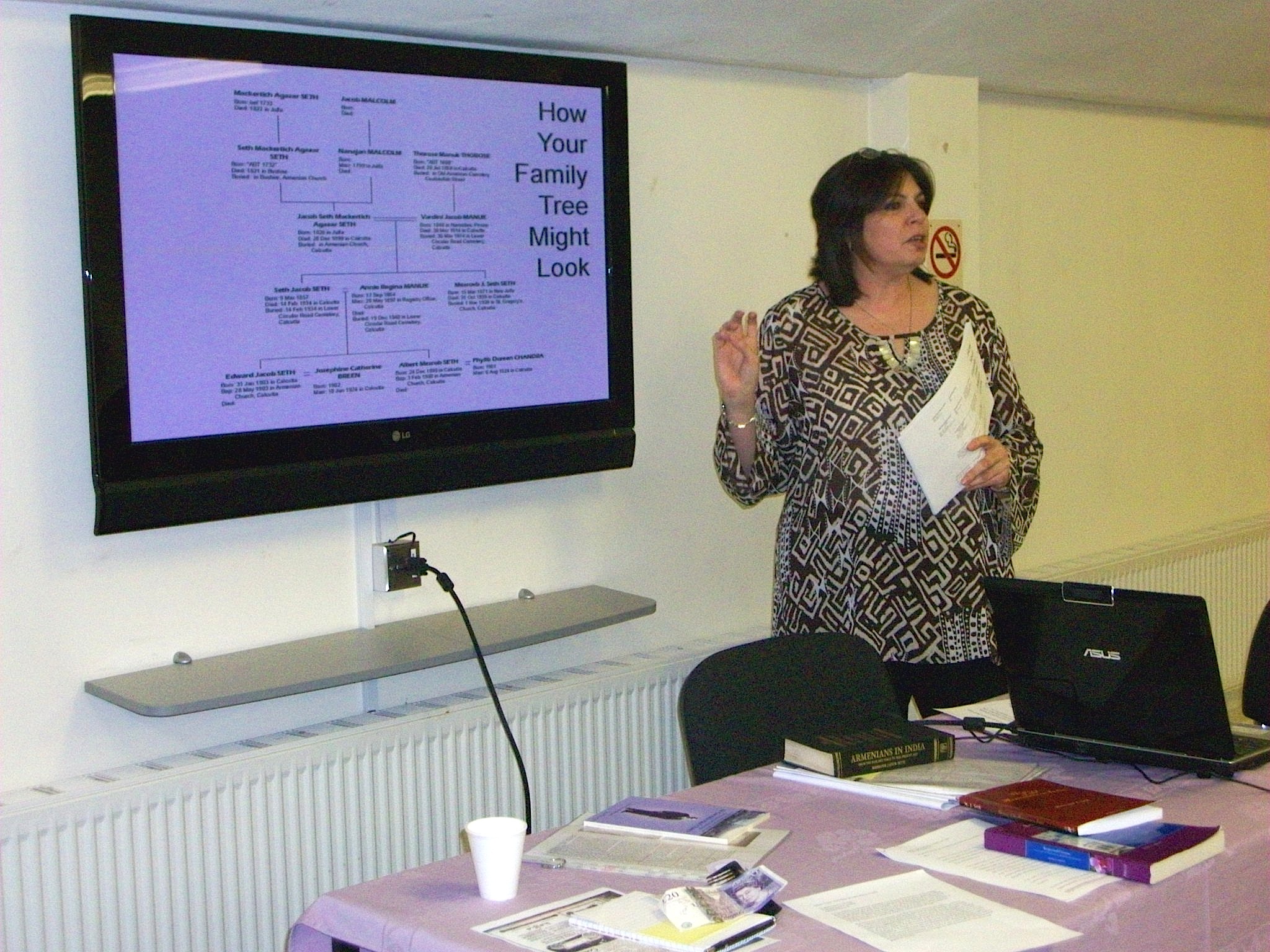
Hi thought your readers might be interested in the latest presentation I have done on Sir Paul Chater and Armenian Genealogy. NEWS RELEASE 21st February 2011 Sir Catchick Paul Chater and Armenian Genealogy Presentation in London By Liz Chater Liz Chater, a UK based family history researcher specialising in Armenians in India and the Far East, was invited by the Centre for Armenian Information and Advice (CAIA) Acton, London http://www.caia.org.uk to participate in their annual programme of Armenian Cultural awareness taking place during February and March of this year. The programme commenced on Sunday 20th February, and Liz began the session by speaking about Sir Catchick Paul Chater, an Armenian born in Calcutta, but whose life was spent in Hong Kong. She spoke about his early life, his family and his life’s work in Hong Kong. Liz also showed a short documentary film on Sir Paul Chater which was made in 2005 by the Armenian Church, Kolkata and ended with an interesting and lively question and answer session from the participants who attended. The second half of the programme was dedicated to Armenian family history and how to use the sources and resources of the internet to successfully trace ancestors. Through a PowerPoint presentation Liz showed how the many genealogy based websites on the internet enable the new researcher to look for information with comparative ease. This was a fantastic and friendly interactive session where Liz encouraged questions from members of the participating group who were eager to explore the resources brought to their attention by her. Many of them were surprised at the depth and breadth of the details available. Supplementing the presentation Liz also brought along a variety of documents she has acquired as part of her own research of Armenians in India. Of particular interest was an example of one of the earliest Armenian Wills she has which is dated 1761 and she explained how important genealogical information can be obtained from such documents. Misak Ohanian Chief Executive Officer and organiser of the cultural programme at CAIA thanked Liz for presenting such a diverse range of information in the short space of time available and hoped that she would return to do a second presentation at a future date. As part of Liz’s research on the Armenians of India and the Far East, she recently added to her website a slideshow which presents all the old Armenian churches that once had a flourishing community in Asia, this can be viewed at http://myweb.tiscali.co.uk/emcjnd/. Liz Chater is an unsupported and unfunded family history researcher specialising in Armenians in India. Liz is currently without a sponsor to enable her to continue and complete her research and publish it. She would be delighted to hear from anyone willing to consider sponsorship of the continuation of her research. Further information can be obtained from Liz at liz@chater-genealogy.com or her website www.chater-genealogy.com. ENDS

-
Hello, I wonder if anyone can help do a translation of this old Armenian tombstone please? Here's hoping someone can help. many thanks Liz

-
Hello all, I wonder if I could ask any of you to help please? I still have several hundred photos of Armenians graves in India untranslated. Although I am deeply grateful to all those who have helped in the past, I really need to be able make my progress on the project a great deal more swift. Therefore I wonder if I could impose upon your time and ask if any of you could possibly help/volunteer to translate the graves for me please? I would of course give you due recogntition and acknowledgement on my website for any assistance given. I have large high resolution pictures which probably wouldnt be accepted here on this forum, (some of the pictures will need serious close up inspection, hence the high resolution) so if anyone is able to offer assistance, please email me [brio1 at tinyworld. co. uk - email broken up to try and avoid spammers] and I can send you the pictures directly. Many thanks for your time on my request. best wishes Liz Chater
-
Hi Thanks for picking up on the article, and placing it here, it is nice to know that people are interested. best wishes Liz
-
Hi everyone I have just come back from Syria where I gave a short presentation in Aleppo on the life and work of Sir Catchick Paul Chater. Here is my press release for those who are interested. Liz Chater, a UK based family history researcher specialising in Armenians in India and the Far East, was in Aleppo, Syria on Sunday 28th February. At the kind invitation of Hagop Mikalyelian she gave a talk on Sir Catchick Paul Chater. The short presentation took place at the AGBU Club (Armenian General Benevolent Union) where she was given a very warm welcome. Liz talked about Sir Paul Chater, an Armenian born in Calcutta, but whose life was spent in Hong Kong. She spoke about his early life, his family and his life’s work in Hong Kong. Liz also showed a short documentary film on Sir Paul Chater which was made in 2005 by the Armenian Church, Kolkata and ended with an interesting and varied question and answer session from the participants who attended. Whilst in Syria Liz also spent time in Damascus. In addition to her commitment to help families researching their Armenian ancestry, she is also a volunteer for The War Graves Photographic Project www.twgpp.org whose aim is to photograph in excess of 1.75 million graves or memorials from Commonwealth Nations and many from other military forces and locations around the world. It is a joint venture run with the Commonwealth War Graves Commission http://www.cwgc.org/. Liz took the opportunity to spend some time photographing all of the Commonwealth War Graves in Damascus. She has already contributed photographs of war graves from India and Afghanistan and she fully understands that sometimes it is often the photographs of the graves that can give some comfort to the families of lost loved ones. As part of Liz’s research on the Armenians of India and the Far East, she recently added to her website a slideshow which presents all the old Armenian churches that once had a flourishing community in Asia, this can be viewed at http://myweb.tiscali.co.uk/emcjnd/. Liz Chater is an unsupported and unfunded family history researcher specialising in Armenians in India. Liz is currently without a sponsor to enable her to continue and complete her research and publish it. She would be delighted to hear from anyone willing to consider sponsorship of the continuation of her research. Further information can be obtained from Liz at liz@chater-genealogy.com or her website http://www.chater-genealogy.com. ENDS
-
Dear All, It has been some time since I made a posting so I would like to remind anyone interested in their Armenian family history in India that my website has had substantial updates during the year, with even more pictures and transcriptions of graves being added. Information is FREE so take a look http://www.chater-genealogy.com. In addition, I have put together a nostalgic look of the various Armenian churches in India and the Far East in a slideshow. The link can be found via my website, alternatively the direct link is http://myweb.tiscali.co.uk/emcjnd/. May I wish you all a very happy and peaceful Christmas and New Year. Best wishes Liz Chater Researching Armenians and Chater in India and the Far East www.chater-genealogy.com
-
Liz Chater, an enthusiastic and dedicated researcher of Armenians in India and the Far East attended the unveiling of a bust and wall plaque of Sir Catchick Paul Chater in Hong Kong on the 1st September 2009. Liz was invited by the directors of Hongkong Land to unveil these unique tributes as part of their 120 years celebration. The bust and plaque were commissioned by Hongkong Land because they felt that such a tribute and acknowledgement to Sir Paul who co-founded the company in 1899 was something that until now had been overlooked. Created by the renowned famous sculptor, Mr Chu Tat Shing, Mr Chu has completed many sculptural works including Dr. Sun Yat-sen statue at the Dr. Sun Yat-sen Museum and the Anti-SARS Heroes statues. His works are well recognised by the public and the Hong Kong Government and he was awarded the "Medal of Honour" in 2008. The sculptures will be permanently displayed in Chater House, on Chater Road to enable visitors to learn about this remarkable man. The ceremony was followed by the opening of the Time and Evolution exhibition of Central at the Rotunda, Exchange Square, where Liz was again asked to help open this retrospective view of Hong Kong. Liz’s family ties and her commitment to researching Sir Paul have made her a leading authority on his life and achievements and she was delighted to attend and lend her support to Hongkong Land. She said: "It is truly a wonderful day today, I feel privileged to be included to share this occasion. For as long as I have been researching Sir Paul Chater, I have wondered why there was no real tribute or memorial in Hong Kong to him. Hongkong Land has achieved a first because this is the first time Sir Paul has been cast in any kind of statue. I am delighted to have been part of this unique ceremony where, at last Hong Kong can gaze at someone who made a difference here." It is widely considered that Sir Paul Chater was the man that firmly placed the footprint of Hong Kong down allowing it to become one of the leading economies of the world today. He was a great man of industry with an amiable disposition. His vision for Hong Kong in the late 1890’s and early 1900’s was breathtaking, exciting and vibrant. He built with flare and architectural elegance; formed and developed companies with longevity in mind. It is no shy fact that his hard work and devotion to the colony’s commerce earned him wealth beyond his imagination but that wealth also brought responsibility. He erected St. Andrew’s Church in Kowloon entirely out of his own personal income, a few years later he erected the Chaplain’s house and later on the Church hall. He gave generously to the Union Church in Hong Kong, even though he did not attend, and there were an extraordinary amount of charitable donations made by him during his lifetime that were never made public. He was an Armenian from Calcutta with an impressive family pedigree of extremely outstanding pious and dutiful Armenians in India. Paul Chater upon his passing, left generous bequests to some family members and nephews and the remainder of his considerable personal wealth was left entirely to the Armenian Holy Church of Nazareth, Kolkata, whose own strong and substantial financial buoyancy today is because of Sir Paul Chater’s exemplary generous legacy to them. Whilst in Hong Kong Liz brought with her from the UK her private family album full of unseen family and historical photographs from Sir Paul Chater’s life. It is a companion pictorial record to her manuscript biography of Sir Paul Chater. She said: "I hope one day that I can generate enough interest for this research that I have carried out on Sir Paul to be published into a book, as remarkably there is no biography on him." Vaudine England author of The Quest of Noel Croucher, Hong Kong’s Quiet Philanthropist said: "when I was writing my book on Noel Croucher I learned of Sir Paul Chater, as he was the 'big man' who gave Noel his first leg-up in business. I thought I would just check the details in the Chater biography - and was amazed to find that there wasn't one! Liz has done a remarkable job, researching the life of Sir Paul Chater. It's a real shame that none of the major Hong Kong companies he started, or indeed the Armenian Church in Kolkata who received his estate after he died, have yet chosen to help Liz get this untold story published. It's a great rags-to-riches story - he’s the most famous Armenian from India who became a pivotal figure in early Hong Kong - and it would be fascinating to bring it all together." Liz pointed out that she had extended discussions with the Armenian Church committee and wardens in Kolkata a couple of years ago and although they admired her efforts they did not feel they could help her conclude her research and publish a book on him. Liz continues to look for a serious sponsor. The exhibition on CENTRAL runs until 30th September 2009. The bust and plaque are permanently displayed in Chater House, Chater Road, Hong Kong. For further information please contact Liz Chater: Email. Liz a t chater-genealogy.com (please insert the "@") Web: www.chater-genealogy.com END OF NEWS RELEASE
-
Following on from the article a couple of months ago about the neglected Armenian cemetery at Hyderabad, I have put together a web page on the graves and Photos of the Armenian cemetery at Hyderabad. http://freepages.genealogy.rootsweb.ancest.../haiderabad.htm Best wishes Liz
-
Through the AGBU in Damascus I would like to tell you about a new virtual way to enhance your language, history or cultural knowledge of Armenia. It has been a long time in the planning stage and now they are about to launch "The Armenian Virtual College". It's a fantastic idea and I shall certainly be trying to learn Armenian via the AVC! Take a look, it's a brilliant idea. http://www.avc-agbu.org/home.php
-
http://www.indianexpress.com/news/An-Armen...--fading/472575 An Armenian link, fading Alokparna Das Posted online: Sunday , Jun 07, 2009 at 0245 hrs From a distance, it almost looks like a mosque, complete with a dome and mini minar or chhatri-like projections on its four sides, of which only two have survived. Its peeled-off plaster and dilapidated state reveal layers of slim bricks dating back to the later Mughal period. A closer look and one can spot a plaque announcing the Armenian Association in Kolkata as the trustee of the place. A faded signboard identifies the building as a nearly three-century-old Armenian chapel. Located near the Kishanganj Railway Station in Sarai Rohilla area, this is the only surviving Armenian place of worship in the city. Built most likely around 1781-82, this rundown building and some tombs at its back survived the Revolt of 1857 only to be encroached upon by a colony that’s now called the ‘Christian Compound’. The place was not always as congested as it is now. Professor A. Dasgupta, a retired Delhi University teacher, has fond memories of a quiet cemetery and a medieval structure adjoining it when she stayed in the vicinity as a child. “The solitude, the all-pervading silence and shaded greenery of the cemetery, the adjoining kuchcha road with no habitation, except the railway colony, are part of my cherished memory of the place. Every day, I was taken for a morning walk to the place. Of all the graves, that of a six-year-old girl used to haunt me—perhaps because I was a child myself,” she says. Now, the cemetery has been almost eaten up by encroachers and flower pots, unused cans and discarded mattresses lie on the graves. The chapel does not figure in the ASI list of protected monuments. The local residents, however, say that they have been “protecting and preserving the church”. “We—around 60 Christian families—have been living here for 40-45 years and this is our church,” says Vinod Dayal. “A priest comes here from Tees Hazari for the Sunday service,” says Michael. Asked about tombs and tomb stones, they say that some have been taken away by “the government authorities and some have just fallen apart”. Inside the chapel, white-washed arches have the Cross below them. Outside, narrow pathways lead to a cluster of small homes and courtyards with a grave or two. The Catalogue of the Delhi Museum of Archaeology, complied by J.P. Vogel in 1908, and Armenians in India, by Mesrovb Jacob Seth, mention the chapel, the cemetery—identified as Deramao—and tombstones, some of them in Persian. The oldest grave is dated 1782 by these authors. Father Gregorio, who baptised Begum Sumru of Sardhana (her haveli in Chandni Chowk turned into Bhagirath Place), was also buried here in the early 19th century. Unlike Kolkata, which has an Armenian community and where the Armenian Church is a prominent landmark, Delhi’s Armenian connection is almost erased. The Armenians came here during the Mughal period and even held important positions in the emperor’s court. An Armenian trader who became a Sufi poet and a prominent voice of dissent during Aurangzeb’s reign, Hazrat Sarmad, lies buried opposite the eastern gate of Jama Masjid, along with his guru, Hare Bhare Sahib or Sayyid Abdul Hasan. Sarmad, also known as the naked fakir, had a follower in Dara Shikoh, Shah Jahan’s eldest son. The Sufi was beheaded on Aurangzeb’s orders, because he refused to comply with existing religious and societal norms. His tomb was painted red, denoting his martyrdom; his mentor’s tomb was painted green, signifying hope. Poets and qawwals continue to throng the twin tombs during the annual Urs. Armenian places of worship are believed to have existed pre-1739 when the plundering troops of Nadir Shah destroyed most of these places. Armenians like Col Jacob Petrus fought against the British and controlled places like Gwalior. Today, of course, all this is either part of history books or of only archival value. The chapel in Kishanganj, the last surviving relic of Armenians in Delhi, struggles to survive uncared for and may also die a slow death, unnoticed by most. I SINCERELY HOPE THE KOLKATA CHURCH WILL LOOK INTO THIS MATTER.THEY ARE DOING A GOOD JOB RENOVATING THE CHURCHES BUT I PRAY THAT DELHI AND HYDERABAD WILL BE TAKEN CARE TOO.
-
http://www.time.com/time/world/article/0,8...1903175,00.html "If Armenians are to be great then they have to pray," says Father Gabriel Sargsyan. "As long as there is one Armenian left, there will be a church." Perhaps, but only a handful of the 50 or so Armenians left in Khartoum have turned up for mass — held in the evening, because Sunday is a working day in the capital of predominantly Muslim Sudan. After the service, the small group sits on the porch of the St. Gregory Armenian Church, sipping sugary coffee and remembering the days when the pews used to be full. Despite the Khartoum government having 'Islamized' the north of the country through the imposition of Shari'a law, there is no sense of religious persecution here at St. Gregory's. Leaders of the Armenian and the neighboring Ethiopian Orthodox churches say they feel safe in Khartoum, and that the persecution of Catholics and Protestants from southern Sudan is a product of the country's north-south power struggle — the small Orthodox Christian communities pose no threat to the predominantly Muslim government. "We respect the law of the land and stay out of trouble," says Eyasu Tadele, an official of Khartoum's Ethiopian Orthodox Church. (See pictures of Darfur.) The Ethiopian Church, in fact, fares somewhat better than its Armenian neighbor, attracting a flood of worshippers every Sunday. That may be a product of shifting patterns of immigration. Many Armenians came to Sudan as refugees from the mass murder in Turkey that began in 1915, while a second wave of immigrants arrived in the 1950s, seeking opportunities in the newly independent country. St. Gregory's opened its doors in 1957, and at its peak, the congregation was 2,000 strong. But many have since left in search of opportunity in Europe and North America, while the Ethiopian expatriate community in Sudan has steadily grown. "First they were coming because of the political crisis and now because of economic reasons," says Tadele. As much as he appreciates the company of his Christian neighbors, Father Gabriel is concerned that several Armenians have married Ethiopian Christians and Copts, producing children who are taught Arabic or Amharic rather than Armenian. "When one person stops speaking Armenian, our Diaspora is lost," he says. That's why he's working hard to resuscitate the old church school to teach the Armenian language, although with wealthier members of the community having emigrated, he struggles to find the necessary funds. More families are contemplating leaving for fear of a new season of instability as fallout from the international arrest warrant accusing President Omar al-Bashir of war crimes in Darfur. Only a few children remain at the school, but Father Gabriel would be happy to teach even just one student. "Armenia lives through our language," he says. One Sudanese Armenian who claims he will never leave is Jeriar Homer Charles Bozadjian, whose family history in Sudan dates back 100 years. Bozadjian runs a restaurant called Big Bite in Khartoum. "I have never seen Armenia," he says. "Sudan is my home." Despite the imposition of Shari'a law, "This is not like Saudi Arabia," says Wafaa Babikier, who studies Management at Ahfad University for Women in Omdurman city. "Girls have the freedom to do everything." Not everyone answers the call to prayer; women drive cars and attend co-ed universities; and they outnumber men in many offices and educational institutions. Others, like Alfred Taban, editor of the Khartoum Monitor, demur, warning that behind the facade of tolerance is a more hard-core Islamist outlook. "A foreigner would not notice," he says. Taban claims to have been whipped for drinking alcohol in a traditional toast at the birth of a relative's son. But Bozadjian aggressively defends his homeland's plurality. "Sudan is a unique country," he says. "Muslims helped to build this church." But others note that many Armenians left Sudan after their properties were confiscated under the radical regime of President Jaafar Nimeiri during the 1970s. Elizabeth Jinjinian, a 70-year-old businesswoman, recalls how the land of the Armenian club was taken away when the community began to shrink, "We used to have many balls, picnics and parties." Often tempted to join her sons in London or New York, Jinjinian has stayed on to run her small cosmetics business, which has survived years of war and sanctions. "Exports and imports dried up," she says. "We had to get goods into the country in suitcases." Despite the resilience of many of the community's veterans, the efforts of Father Gabriel to sustain his culture in this corner of the Armenian Diaspora face mounting odds. Indeed, the priest himself is slated to leave soon, because the community no longer has the funds to support him. He hopes someone in the community will step forward to run his school. "If you have a school, your nation is going on," he says. The collective memory of the horrors of 1915 may be the most powerful factor in sustaining the community's identity. On the dusty church verandah, Jinjinian animatedly narrates the tale of her mother's escape from Turkey after her grandparents were killed. "She was at the dressmakers so she was saved." Her tale is well known to the congregants, but everyone listens respectfully as a warm breeze ushers in another hot summer.
-
Yes, the Armenian cemetery located at Uppuguda (known as Opiguda in the colonial times) is reduced to a mere dumping zone and a place where people relieve themselves. Armenians came into India as traders through the overland route much before the advent of European traders into India, in fact seven centuries before Vasco-da-Gama reached India. A historian Mesrovb Jacob Seth in his seminal work Armenians in India has noted that 19 Armenians including two priests Rev Johannes (1680) and Rev Simon (1724), were buried in this now deserted cemetery. And the cemetery is not confined to Armenians alone. “With no English graves of 17th and 18th century seems to have existed, even the Dutch used the Armenian cemetery till they acquired their own cemetery in the year 1678,” B Subrahmanyam, a retired deputy director of AP Archaeology Department told Expresso. Referring to a study done by Dr V Nersessian, he pointed out that there was considerable Armenian population in Hyderabad and the community was sent a Pontifical Bull from Holy Etchmiadzin, the spiritual centre of Armenian Chursbiantuow in Soviet Armenia. Realising the importance of the Armenian cemeteries and churchyards, which are the only attested sources of their presence, the D epartment of Archaeology has declared the Uppuguda site as a protected monument under the Archaeological Sites and Remains Act, 1960. But due to sheer negligence, this historical churchyard is reduced to a dumpyard full of liquor bottles and human excreta. When the sorry-state of affairs was reported to the Director of Archaeology and Museums Department P Chenna Reddy, he said that they have included this cemetery in the colonial heritage monuments preservation project in Hyderabad. “The cemetery has been neglected for more than seven years. Before the Central Government releases funds for this project, the department is chalking out a plan to clean the site soon,” an Archaeology Department official said. One can only hope that the condition of this cemetery, where the Armenian-Hyderabad connection is etched, would be improved as soon as possible. Read the article and see a photo here http://www.expressbuzz.com/edition/story.a...A4zQ=&type=
-
Dear All, I have just completed and uploaded Armenian graves in Bombay. Also a list of useful Armenian/Indian Research Publications which people may find helpful. Madras graves are coming, but will take longer as I don’t have an Armenian translator at the moment. Best wishes Liz
-
Hi all Sorry, I'm afraid to my eternal shame I don't speak or read Armenian! I know it was a while ago, but the trip to India by His Holiness was a tremendous success. I speak as one of the team who helped organise the events for the Armenian Church in Kolkata. Unfortunately, there have been no official press releases on the 300th celebrations events from either the Armenian church in India, or Etchmiadzin, although as you know a press release was issued regarding the re-consecration of the the church in Chennai. However, I can report that His Holiness was kept extremely busy whilst he and his entourage were in Kolkata and I am sure they all took away their own special memories of that unique occasion - I know I certainly did and many people around the world did too. There are various photo sharing website such as Piccasa and Flickr that have photos uploaded to them, all of which I believe are freely available for public viewing. If anyone is interested in further details of exactly what went on, then I can give you my personal view point - but I suspect that it is so far in the past now, that other things have probably taken over in interest and importance. But suffice it to say the whole thing was excellent best wishes Liz
-
This book by Deacon Tigran is extremely well researched. Sadly however, it is currently only available in Armenian. The article omits that this book was only able to come into the public domain because of the generosity of the Armenian Holy Church of Nazareth in Kolkata which completely funded the printing and publishing of it in January 2008, and I do hope that they are able to ensure that it is re-printed in English too. It would serve as an excellent reference book in any historian or genealogists library. In the meantime, the photographs of the graves in the book can be freely downloaded from my website, along with 2000+ other historically important Armenian graves in India, Asia and the Far East. Best wishes Liz