Democracy Not Spoken Here
By Peter Eichstaedt and Dina Horwedel
How the poor are betrayed by corruption in Armenia.
It is late May high in the Caucasus, where Asia folds unevenly into the fringes of Eastern Europe. A dismal rain drains from low clouds clinging to verdant slopes in Armenia.
Inside a crumbling concrete building in the mountain town of Goris, more than 100 distraught and desperate people, mostly women, crowd a dim corridor. The stench of an open toilet mingles with damp wool and sheep manure.
They await the local deputy of the Armenian parliament, a man of power and privilege in this country that was once a southern outpost of the former Soviet Union. Most have been waiting for several hours. They want help, a handout, something, anything, to keep them alive.
For many, this is not their first visit. But today might be different, they think, because it is the eve of the parliamentary elections.
“I don’t have any hope that they will help me, but I came anyway,” says a single mother as tears well in her eyes. She clings to her ten-year-old son suffering from trauma whose wide brown eyes peek out from under a baseball cap.
Another young mother jiggles a fussy baby boy with severely clubbed feet covered with hand-knit yellow and green slippers. He needs surgery.
Our translator tells her of a free clinic in the country’s capital, Yerevan, where they will perform the surgery for free. But, she cries, she can’t afford the $10 US for the four-hour journey in a broken down minivan over rugged roads.
The women’s stories are similar. Their men left long ago seeking jobs in Russia, the Middle East, Europe – anywhere. Many never return, leaving the women to raise children on a diet of cabbage, carrots and potatoes grown in small plots of land during the short growing season. Some have sheep or cows, if they can afford to keep them. Barter is common.
“No one likes to come here and beg,” says one woman. “If they would help create jobs, we will earn our own money.”
We are in this place because we’re election observers, two of several hundred foreign volunteers spread throughout Armenia to document the status of democracy.
Three doors down from the parliament deputy’s office is the local newspaper office where we sit with editor Greta Grigorian and her small staff. A resilient woman in her mid-50s, she relishes the fact that she can keep her newspaper alive by demanding substantial sums from local political bosses in exchange for printing their self-flattering remarks.
She snickers at the crowd in the hall and rubs her fingers together. “They want money. They’re selling their votes,” she says. Grigorian recently interviewed a woman who asked the deputy for a new toilet. She laughs about another man who asked the parliament deputy to help with his wife’s infertility.
. It is a dark joke. Most members of parliament and ranking government officials live lavish lifestyles, own opulent houses and control the country’s major businesses, casinos and bordellos, in large part because they are exempted from criminal prosecution. One leading political figure reportedly suffered a near fatal hemorrhage after he overdosed on sorryyyyy while cavorting with young women. The incident left him incontinent.
Despite the pathos of poverty and like all former Soviet republics, this country’s ruling elite wheel around in fleets of gleaming black Mercedes SUVs driven by bristly, thick-necked men wearing bulging black leather jackets. And don’t get in their way. They use horns instead of brakes.
Grigorian dismisses it all with wave of her hand then motions for me to help myself to plate of cold meat, white cheese and the folded flat bread they call lavash. As I do, she twists off the top of a one-liter plastic Coke bottle and pours healthy shots of the home made vodka known hereabouts as “kara-hunch.”
The vodka is gritty and harsh, well over 100 proof, and carries the pungent flavor of the mulberries from which it is made.
“All the bosses here are Republicans,” she explains, the party of the top political figures in Armenia: the prime minister and the defense minister. The party bosses have been hard at work, she says, intimidating much of the local population by claiming that they have ways to know how people will vote.
It’s a ridiculous claim, but effective, playing on paranoia inherited from the former Soviet Union. “We know the vote is secret, but people, especially illiterate people, believe their bosses who tell them they will know how they vote,” Grigorian says. “They are scared to death to lose what they have.”
“The candidates are criminals,” she continues. “Under Communism, the candidates had to be educated, come from a specific background. But now that Communism is gone, men lacking balance in their minds are running the country. There are beatings and struggles and these men only know violence.”
The candidates can afford to pay the bribes because they call on and bully people who owe them favors to do so for them, one staffer says. “They get others to pay for things, and then take credit for it.”
Despite all this, she is looking forward to tomorrow’s election. The incumbent deputy faces opposition from a rival candidate who has rallied strong support. “It will be a fight between two lions,” she says with the relish of small-town bookie collecting bets on a bare-knuckled brawl between two neighborhood toughs.
She favors the incumbent, she confesses, because he is respected locally and has status and influence in the capital. Without him to keep a lid on things, she says, rival factions in the region would be shooting it out on the streets of Goris.
A reporter raises his glass and toasts our mission. “Let people live better and never need to come here like this,” he says. We down our shots and sit in silence for a moment.
On a ‘50s-era radio, the quavering strains of a Russian folk song give way to the somber opening of a Tchaikovsky piece. “This is music they play when someone dies,” Grigorian says. “Perhaps they play it for tomorrow.”
* * *
The sky is pale blue as sun streaks across the mountain peaks. Yesterday’s rain has left the pastures sparkling and sprouting with delicate yellow and purple flowers as we bump and swerve our way over roads pitted with pot-holes.
We arrive at our first polling station 10 minutes before 8 a.m. The tethered cow we saw yesterday still grazes on the patchy grass of this community center now fallen into disuse. His hair damp from the misting rain, the shepherd had told us he liked the election because he’d been hired to shovel mud off the sidewalks. It meant pay for a couple of days.
Inside, the precinct chairman, a gruff character named Artur Shalounts, has just unlocked the safe containing the officials ballots and is distributing them to his eight other commissioners while a handful of party proxies settles on rickety chairs for what is going to be a long day. A telephone has been rigged by stringing a wire from outside across the high ceiling, where it dangles down to a small wooden table. The floor is pitted and cracked concrete, the walls chipped and mud-stained plaster painted a sickly pale green.
The ballot boxes are clear plastic containers like Americans use for storage, each with an opening in the lid, which is secured with green plastic ties. They were specially made then flown in from Denmark, a donation from the European community. The ballots themselves are official pieces of paper hand signed by three precinct commissioners and stamped. No possibility in Armenia for dimpled chad.
Outside a group of middle-aged men dressed in black suit coats thrown over patterned sweaters mill about the yard, smoking hand-rolled cigarettes and talking. “Are there large groups of people not waiting to vote standing in front of the polling station?” asks the official observer’s report form.
Well, yes, but this is a mountain village in Armenia, and election day is the biggest thing going. It isn’t as if these men can tune in to a baseball game with their feet up on a chaise lounge this sunny Sunday.
Shalounts tells us that voting will be slow in the morning because most folks will take advantage of this break in the weather to tend their gardens, which unlike the activities of this election, will ensure they eat again next winter.
After an hour with just a trickle of voters, an argument breakouts in the yard. An older man wearing a black wool beret bellows at the local community leader, who lingers around the polling station the entire day and night. Alerted to voter intimidation, we pull out our forms with pens at the ready, but our interpreter, Rouzanna, tells us, it’s “just an argument about land.”
* * *
We drive up into the mountains past more sunny meadows now glowing yellow-green and dotted with flocks of sheep. We turn onto a muddy road that takes us into the village of Tegh, a community perched atop steep slopes riddled with caves that until recently served as homes for some. Our driver dodges strutting turkeys and chickens, and an old man, his back bent perpendicular to the ground, labors alongside the road supporting his weight on a stick.
Outside the polling station several hundred soldiers in green camouflage wait in the sunshine for their turn to vote. This and another polling station we will visit are close to the Nagorno-Artsax region, an autonomous region once part of Azerbaijan but now controlled by Armenia. It is not recognized by the international community despite having been wrested from Azerbaijan during a two-year war in the early 1990s, a war that cost some 30,000 lives and spawned an estimated 750,000 refugees in both countries.
The war is quiet now, due to a cease-fire brokered by the Russians in 1994. A resolution to this and other smoldering conflicts throughout the Caucasus region remains elusive as Armenia, Georgia and Azerbaijan lurch and stumble through their election cycles this year.
The potentially explosive outcomes to these elections has drawn scant international attention to the region in general, and the Nagorno-Karabagh conflict in particular, despite frenzied work on a massive $3 billion, 1,000-mile oil pipeline from the Caspian Sea city of Baku, Azerbaijan, across the Caucasus and to the Turkish Mediterranean city of Ceyhan. The pipeline has attracted a swarm of investors, lead by oil major British Petroleum, and will pump significant quantities of oil from the rich Caspian Sea oil and natural gas fields to western markets.
The pipeline passes through Georgia not far from where the Chechens, who in addition to fighting the Russians in two wars this past decade, were among the Taliban fighters in Afghanistan and are now holed up in a remote valley called the Pankisi Gorge.
The Bush administration dispatched a unit of special forces to Georgia more than a year ago to train the Georgian army to fight the Chechens who are fond of blowing up pipelines. They have found marginal success, in part because the Georgians dislike the Russians more than the Chechens.
Once oil starts to flow sometime next year, however, tensions between Azerbaijan and Armenia over the Nagorno-Karabagh region could flare, threatening the regional peace-and-stability mantra recited by the Bush administration operatives.
Results of the recent Armenian presidential election and the coming fall presidential election in Azerbaijan do not bode well for an end to the conflict.
In the March 5 run-off, Armenia re-elected President Robert Kocharian to a second five-year term. Before becoming the prime minister of Armenia in 1997, Kocharian was the political and military leader of Nagorno-Karabagh.
Since assuming the presidency of Armenia in 1998, he has met almost 20 times with Azerbaijan president Heydar Aliyev about the Nagorno-Karabagh conflict, but to no avail. One such meeting was in Key West, Florida, in the pre-9/11 days at the behest of Secretary of State Colin Powell.
Aliyev faces re-election in the fall – if he lives that long. Now 80 and in seriously failing health, the former Soviet Politburo leader recently collapsed twice during a televised state address. He dismissed the mishap as an “evil eye,” or spell, that had been cast on him.
This fueled speculation among the opposition that Aliyev was finished, prompting a government crackdown on newspapers for allegedly distorting the truth of the incident. Meanwhile, Aliyev’s son Ilham, a key executive of the state’s lucrative SOCAR oil company and the likely successor to the presidency, announced that his father had suffered a cracked rib. Aliyev was flown to a Turkish military hospital to recover.
While Aliyev hopes to pave the way for his son, opponents have other ideas. A leading opposition candidate is Rasul Guliyev, a former Azerbaijan parliament speaker who now lives in exile. At the request of the Azerbaijan government, Guliyev was detained May 1 in the Netherlands on an Interpol arrest warrant for alleged misappropriation of government funds.
Dutch immigration officials released Guliyev the following day after deciding there was a lack of evidence to keep him in custody. Guliyev may have sufficient support within Azerbaijan to mount a serious challenge to Aliyev, which may be why Aliyev’s authoritarian government asked Interpol to intercept him. Aliyev wants Guliyev's extradited to Baku and locked away like a host of other political prisoners he has jailed despite vehement protests from the European community.
Guliyev served in the early 1990s as Azerbaijan’s deputy prime minister in charge of the oil sector and maintains close ties to the oil industry. In recent years he has emerged as one of Aliyev's fiercest critics and despite living in exile, has served as a leader of the opposition Azerbaijani Democratic Party.
As Azerbaijan moves toward elections, the anti-Armenian war rhetoric over the Karabagh region has escalated. In early May, protesters in Baku marched on the offices of the UN and the Organization for Security and Cooperation in Europe (OSCE) which is trying to broker a resolution to the status of Karabagh. Calling themselves the Karabagh Liberation Organization, they chanted, “Karabagh or death.”
* * *
Back at the polling station in Tegh, the soldiers are checked at the door by police, who were not, according to our official observation forms, supposed to be present unless invited. But they were invited, our precinct chairman says, to regulate the flow of young soldiers streaming into the polling station.
The voting is in a decrepit theater with buckled and heaved floorboards from a leaky roof. The polling booths are makeshift tables shrouded by raggedy bedspreads. A bearded man lords over the two ballot boxes: one for the parliamentary election and the other for the constitutional referendum. He yawns occasionally, scratching his beard with an orange neon ruler he jabs in the slot to pack the ballots deeper. He barks at confused voters to ensure they place the right paper in the right container.
After 30 minutes, we grow restless. Were there elections in Communist times? We query our proxies. Yes, but no one bothered to vote, we’re told. The choice was one candidate -- so much for the power of the proletariat. But this election is far different from that by-gone era.
Some 21 parties, a mere fraction of those duly registered, have been permitted to field candidates. Most have names that are various combinations of the words homeland, law, order and justice, but not more belligerent than Fist of the Armenian Brave. We learn that it can also be translated as Fist of the Armenian Aryans.
Outside, the old man we saw trudging down the road has arrived to vote. He wears a smile and a sweater that has been repeatedly darned. He shuffles along in broken down black shoes and clutches his stick with thick, gnarled hands. Why did he vote? “It is my duty,” he says. “I am the oldest in the village and I have to be an example to the others.” He looks to be 95. He’s 69.
At a polling station on the other side of the village, we get a taste of reality. After a cursory check of the polling procedures, we step outside to find ourselves in the midst of a couple of hundred soldiers gathered around an officer speaking to them in measured tones but loudly enough so that all can hear.
“You know your duty,” he says. They nod and murmur. Our interpreter asks a soldier if he has been told how to vote. Yes, he says, for the party of the prime minister and the defense minister. The officer then climbs into his gleaming white Volga and leaves.
* * *
Famished, we return to Goris and find a crude restaurant that overlooks the tumbling white water of a river that flows through the heart of town. Our driver, Artum, orders the standard Armenian fare: barbecued pork and lamb called horovats which is taken with lavash, mild white cheese and fresh green herbs, and a salad of cucumbers and tomatoes.
It is a peaceful place, with freshly budded trees stirred by a warm breeze in the bright sun. For the moment, the election seems part of some other reality. Here the husband is the cook, a burly man with a substantial girth and a five-day growth of beard. He labors over an open stone pit carefully roasting the meat as his wife wipes down our table, sets plates and silverware, and delivers our bread and cheese.
Our beverages come with a small bottle of homemade vodka, compliments of the house. I marvel at the generosity of these people scratching out a meager living. As we eat, a battered and smoke- belching dump truck empties a pile of sand not far from our table. The little restaurant is under construction, and despite the annoyance, I sense hope for this ancient land.
History weighs heavy here. Armenia claims to be the world's oldest Christian country -- the religion officially was adopted in the year 301 -- yet today is precariously situated between Muslim Turkey to the west, Iran to the south and Azerbaijan to the west.
At the dawn of the 20th century, amidst the chaos of World War I, some 1 million Armenians died at the hands of the Turks -- an ominous prelude to the Holocaust and the reason that Armenia's border with Turkey remains closed.
Armenia briefly flashed across global television screens in 1988 when its northern regions were leveled by a devastating earthquake, the scars of which are still visible 15 years later. Then, in late October 1999, gunmen charged into the Parliament and fatally shot eight officials, including the powerful prime minister and speaker, in front of television cameras.
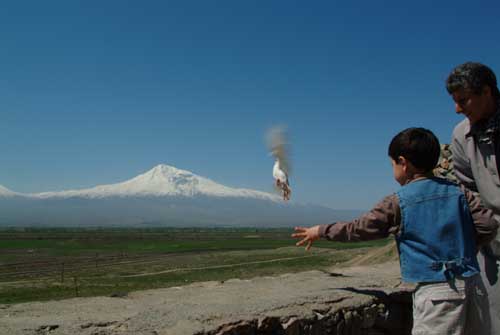
This haunting past looms over Armenian politics much like the snowy Mount Ararat, where the biblical Noah landed his ark in what is now Turkey and which dominates the landscape south of the capital city.
Long before this election, the verdict on democracy in this and other former Soviet republics of the region may have been delivered. Only 13% of those in a recent poll by the Center for Peace and Democracy agreed that free and independent elections were possible in Armenia.
A look at the Armenian presidential election earlier in the year reveals the facade of democracy that covers the Caucasus and most of the central Asian republics.
Kocharian’s campaign manager was the wealthy and powerful defense minister Serg Sargsian, who opened up campaign offices all over the country, often in government buildings.
As the campaign progressed, Kocharian dominated the airwaves and newspapers, even those traditionally critical. Both in the initial round of voting, which featured nine candidates, and the runoff, a legion of local and foreign observers reported rampant abuses.
Poll watchers were intimidated, wads of pre-marked ballots were stuffed into the clear plastic ballot boxes, and in approximately 40 polls, the number of votes reported wildly exceeded registered voters.
The election observation mission, organized by the Council of Europe and the OSCE, exercised diplomatic restraint when it concluded that the election “fell short of international standards.”
The run up to the election provided unmistakable clues to outcome.
More than a year ago, Kocharian's security guards cornered a man in the toilet of an outdoor café and beat him to death after he shouted insults at the president, who was having a drink with a French-Armenian celebrity. One guard was tried, convicted and given a suspended sentence.
Then the plug was pulled on the country's most popular and independent television station by a presidentially appointed commission formed to regulate radio and television. It took six months for a bland replacement station to get up and running.
In the fall of 2002, a local journalist was badly wounded when a man tossed a grenade at his feet on a busy downtown street. The journalist was researching the lack of progress in the trial of the gunmen charged with the October 1999 shooting.
And in late December, the head of the state television was shot to death on the steps of an apartment building. He reportedly was in the camera booth in the parliamentary chamber when the shootings occurred and knew of a missing 11-minute segment of the videotape of the event -- footage that allegedly implicates some key figures.
Then just prior to the first round of the election, an opposition party official and member of parliament visited a small agricultural town of Artashat south of the capital in the heart of Armenia’s grape-growing region.
He barely escaped alive. Wanting to stump for his party’s presidential candidate, he was attacked by a small and antagonistic crowd and stabbed after drawing a gun and shooting into the air – a move he says was made in self-defense. The village mayor later announced that if any one came to his town to campaign for anyone other than Kocharian, he could not guarantee their safety.
Disorganized and divided, there was little the Kocharian opposition could do but complain. And complain they did, with frequent rallies and marches through the city.
“Those who have raped the will of this country will in turn be raped,” one speaker bellowed from the steps of the country’s ancient manuscript museum, his words echoing off the bleak apartments that line the street.
In the days before and after elections, several hundred protestors, including opposition campaign staffers, were rounded up and arrested, often in the predawn hours in their apartments. After brief and closed hearings, most were jailed for 15 days, or fined and released.
The arrests were made under an obscure administrative code that bans attendance at “unapproved” political rallies. The rule remained on the books from the Soviet Union days, but is not longer valid, defending attorneys complained, so officials turned to other equally obscure rules to justify the arrests.
By comparison, this parliamentary election seems eerily calm.
* * *
In the early evening we return to our first polling station to watch the vote count. The heavy metal doors with windows close more or less at 8 p.m. Two unarmed policemen wearing the high-crowned, Soviet-style military hats solemnly guard the entrance. Some men stand on tip toe, noses pressed to the glass, silently peering inside while others huddle outside talking quietly and smoking.
As dusk descends, bare lightbulbs casts weak light as ties to one ballot box are cut, and one by one, Shalounts extracts a ballot and calls out “for” or “against” the constitutional reforms. After an hour, the pile of ballots seems as large as when he began.
We let it be know that we are in dire need of a bathroom break because the toilet in this place was once a Turkish toilet, a ceramic hole in the floor, but is clogged with debris and excrement.
Dressed in a white blazer, black pleated skirt, immaculate white hose, and black patent leather shoes, one of the proxies leads us outside and down a dirt path as she expertly picks her way across the uneven and muddy ground strewn with cowpies and sheep piles to what looks like a barn. She tugs on an ancient door.
A chink of light from a narrow hallway with rough-hewn floors helps us find our way. She opens the door immediately to our left to reveal a bathroom. It is decidedly Western and modern, despite its cinderblock walls, with mortar dislodged between two blocks to make way for someone’s lesson book.
Later in the hallway, we kick a rubber soccer ball with five little boys ranging in age from five to 13. The littlest, hanging back and clinging to the wall, launches into a chorus of Jingle Bells, sung in heavily accented English. We laugh and join in while his mother claps along. He next treats us to a rendition of the ABCs while we drink mugs of cold spas, a soup made of yogurt and rice, provided by his mother.
As the night slowly grows older, the chill of the mountain nights fills the unheated dusty concrete room. We burrow into our jackets, gloves, and hats while people wearing little more than business suits or dresses look on in amusement. A woman with short-cropped orange hair paces the floor, eyeing us as she hugs her belly and groans. Our translator is amused and unsympathetic, saying the woman had a gall bladder operation a couple days earlier. “She wants us to see how much she suffers so we know that she is committed,” she remarks.
Despite her apparent discomfort, the woman whispers something to a young man, who disappears and returns with his arms filled with woolen blankets that are shared among us.
Meanwhile, Shalounts continues to painstakingly remove each ballot from the box, read it aloud, then ceremoniously hand it to the other commissioners duly keeping the tally. Rouzanna relays comments from a young women working as a proxy. “He does this for you,” she says of Shalounts. “If you were not here, this would take 30 minutes. But because you are here, he will prove he is doing his job, and this will take all night.”
The count drones on, hour after hour, as the room fills with the acrid smell of hand-rolled cigarettes and the sound of Shalount’s voice calling out the marked ballots.
The name we hear nine times out of ten is “Azoyan,” the local member of the Republican party, and a man we met two nights earlier. Like almost all politicians in this country, he’s a survivor from Soviet times. He managed construction projects in the region, then was a guerrilla commander during the Karabagh war.
He was introduced to us as “our candidate” during our first evening in the hotel. Over drinks, he asked what we thought the odds were of Russia and Europe joining forces in a war to fight the United States and Great Britain. Despite the ineptitude with which the Bush administration handled our European allies over the Iraq invasion, we assured Azoyan that such a war was unlikely. He shrugged, then asked why the US didn’t help Armenia obtain Turkey’s recognition of the Armenian genocide. We said it was too complicated to explain.
* * *
It is 3:30 a.m., and the count is drawing to a close. Everyone is bone weary and cold. We huddle around a heater, nothing more than a glowing coil of wire set in a stone, and powered by bare wires stuck into a broken socket high on the back wall. A white-haired man, the proxy for the Communist party, lights his 568th hand-rolled cigarette of the evening as he quashes one still lit with his other hand in an overflowing ashtray.
The haze of smoke hangs in the air like a thin fog as Shalounts announces the final vote totals. The community leader makes several frantic phone calls to god knows who. We watch from the corner, loathe to leave the heater that warms our hands and faces. A drink would be great now.
The young proxy from earlier drags us from the drowsy comfort of the heat, imploring us to watch from closer quarters then argues with Shalounts about the total votes for her candidate. She brandishes a notebook in which she has ticked off votes for her candidate as they were announced. She demands a recount on the spot. “Please, stay here with me,” she begs. “They counted wrong.”
We explain that if she wants a recount, she needs to file a complaint with the territorial election commission the following day. But Shalounts has already ripped open the once-sealed package with the man’s votes and they proceed to count ballots together. Clearly done for us, and to save face in front of his peers, it is obvious to everyone, proxies and observers alike, that the recount is an exercise in futility.
The candidate’s pile of ballots is one-fifteenth the size of the other stacks. Rouzanna groans and rolls her eyes, knowing that any hope of getting back to our hotel before 6 a.m. is gone now.
The count over, the woman is defeated. “I was wrong,” she mumbles.
We must now wait for an official document called the “protocol” which certifies the vote totals. The process should take five minutes, but this is Armenia, and well, democracy is young here. There is confusion over the totals. Shalounts can’t get the vote totals to match the number of ballots, used and unused. He decides to file the report anyway, noting the discrepancy, then searches for the official stamp required for all business and government paperwork. Five minutes later it is found buried under a pile of papers.
Outside, the lingering men have gone home. The wind stirs and a few night birds chirp. Sunrise is not far off. Shadowy mountains loom under the swath of stars that sparkle like jewelry in the darkness. We climb in the car and head home.
* * *
The next afternoon the hotel owner greets us with a late brunch of roasted pork, bread, cheese, vegetables, vodka and beer. We plead for lots of strong coffee. The patio to his restaurant and the large dining room are packed with men. He explains they are all proxies who worked for Azoyan. It is time to celebrate. The booze flows.
After a long meal during which we discuss the election and try to recapture some sense of normalcy, we wander over to the nearby offices of the territorial election commission. One of our duties was to insure that our precinct report was delivered and properly recorded, along with any requests for recounts.
Our footsteps echo in the hallway of an empty college building where we find the election office padlocked and sealed. A waste can overflowing with cigarette butts stands sentinel near the door. We leave and outside the lilacs are in bloom. In the driveway, a soldier washes a 10-year-old Volga as American rap music blares.
We return to the hotel restaurant where we find the territorial commissioners and staff have replaced the proxies. The patio tables are piled high with food and strewn with bottles of vodka and beer. An argument breaks out because someone tried to make a toast out of turn. We look at each other, shrug, and smile.
Later we learn that our precinct had been unusually calm. A man was killed and two others were badly wounded in a shooting outside a polling station in the same village of Artashat where the parliamentary deputy had been stabbed months earlier. Two foreign observers were in the polling station watching the ballot count at 1 a.m. when Kalashnikovs opened up on a group of men outside, shattering windows in the observers’ car. Police made arrests, but insisted that the shooting had nothing to do with the election.
As we descend from mountain towns past families squatting at the roadside selling fresh mushrooms, we feel relieved. Our driver, whose wry sense of humor has lifted our spirits on more than one occasion, turns and smiles, “Fin de la comedie.”
http://www.redrockrain.com/writtenword_elections.htm