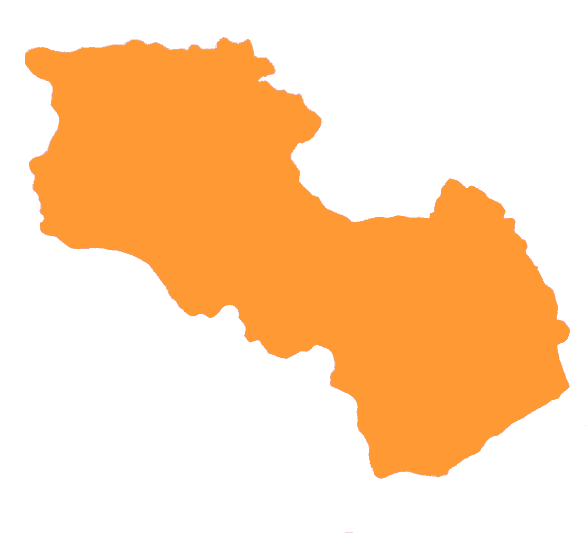
JOURNEY TO ARTSAKH
During August 2003, Abba Seraphim and Father Simon Smyth were guests of Archbishop Pargev Martirossyan, the prelate of the Diocese of Artsakh (which covers Nagorno-Karabagh and adjacent liberated territories of historic Artsakh) of the Armenian Apostolic Church. They were accompanied throughout by Dr. Manuk Hergnyan, Executive Director of Vem Armenian Radio.
We set out for Artsakh in the delightful company of Dr. Eduard Danielyan, head of the research group studying ancient and early mediaeval Armenian history at the National Academy of Sciences of the Republic of Armenia and Head of the Chair of Area Studies in Yerevan State Linguistic University, where he teaches Area Studies of Britain and Armenian history. Eduard was an absolute fund of information and every question I posed about Armenian history was answered in great depth and with scholarly exactness. My genealogical interest in the ancient princely dynasties of Bagratids and Artsrunids obviously delighted him and we got sidetracked into discussion of the Armenian diaspora as well as our own family origins. Manuk knew that his ancestors had migrated from Bayazit1 on the western slopes of Mount Ararat (now in Eastern Turkey) in 1828, during one of the many Russo-Turkish wars.
Soon after leaving Yerevan, we crossed the great flat Araratian Plain2, which was dominated on our right by the distant snow-covered peak of Mount Ararat-Masis (5,165 m), soaring above hazy clouds like the New Jerusalem coming down from heaven. It wasn't difficult to understand why Ararat-Masis has such an emotional and symbolic hold on Armenian sentiments. I pondered on the strategic vulnerability of this core of historic Armenia as I imagined the passage of invading armies: Roman, Byzantines, Mongols, Persians, Tatars, Seljuk, Ottoman and Kemalist Turks, who each destroyed the frail independence of Armenian nationhood. As we travelled south and then east into Armenia's southern province of Zangezur (Syunik), the road wound its way through the majestic foothills of the Zangezur Mountains. The name of Zangezur traditionally derived from the geographic name Dzagedzor, the domain of an Armenian patriarch Dzagik. According to folk-etymology, the name means 'the bell that cannot be heard' which derives from a legend about the bell in an ancient church built on the Vorotan River Gorge. The huge bell could be heard for a distance of up to sixty kilometres and served to warn some six hundred villages of the approach of enemies, enabling them to flee into the wooded hills and make their way to the safety of the impregnable Tatev monastery. It is told that the Arab invaders in 8th century tried in vain to destroy the bell until finally they lit a fierce bonfire beneath it, causing the clapper to melt against the side.
After the fall of Imperial Russia, this area withstood the test of time. The Republic of Azerbaijan's claims (supported by Turkey) to the Armenian regions of Nakhijevan3, Zangezur and Karabagh4 met with fierce resistance from the Armenians and became a centre of conflict. In June 1918 during the assault of Turkish troops against the Republic of Armenia they invaded the Nakhijevan region but were defeated by the Armenian regiment led by General Andranik Ozanyan (1865-1927). At the end of July the Turkish forces supported by the Azerbaijani Musavatists captured Nakhijevan, but after the defeat in World War I Turkey had to retreat from the occupied territories, including Nakhijevan (December, 1918). The Musavatists occupied the region, but in May 1919 the military forces of the Republic of Armenia liberated Nakhijevan. In July 1920 Nakhijevan was occupied by the regiments of the 11th Red Army and the Soviet power was established there. According to a Treaty of Moscow (March 16, 1921) signed by Soviet Russia and Kemalist Turkey Nakhijevan was joined to Soviet Azerbaijan. Thus Kemalist Turkey conquered from Armenia the district of Kars and the region of Surmalu (Surb Mariam - St.Maria) on the one hand and helped Soviet Azerbaijan to annex Nakhijevan on the other hand. In February 1923 was formed the Autonomous District of Nakhijevan, which in February 1924 was restructured into the Nakhijevan (the name was misspelled Naxçivan) Autonomous Soviet Socialist Republic amounting to the Azerbaijan SSR. During the years of Soviet power the Azerbaijani rulers realized the policy of deportation of Armenians - the aboriginal population of Nakhijevan. It was accompanied by vandalism - destruction of the Armenian historical monuments, especially of the Christian epoch (churches and khachkars--stone-crosses).
Through the efforts of General Andranik and then the celebrated Armenian commander Garegin Nzhdeh (1886-1955) Zangazur stayed Armenian and did not suffer the same fate as Nakhijevan.
After leaving the main road and following a minor road down a steep gorge made by a tributary of the Arpa river and its tributary5, we arrived at Norovank ('New monastery'), which, like most ancient monastic sites, is dramatically situated on a cliff top. As you can drive right up to the monastery, there was quite a crowd of tourists at Norovank, including a friendly family of American Armenians who interviewed me for their home movie, pointedly asking my opinion as to whether I thought Armenia a safe place for tourists.
http://www.britishorthodox.org/a1.jpg
Comprising three churches, the complex has been restored to its former glory as recently as 1998 through the generosity of a Canadian Armenian family.
This was the lordship of Vayots Dzor6 in the ashkharh of Syunik, once the territory of the Orbelyan family. Originally their members were allies of the Armenian Zakarid princes who headed the Armenian-Georgian military forces for liberation of the region fighting against the Seljuk-Turks (the first decades of the 13th century). Later, when the Mongol invasions began, prince Elikum (the eldest son of the Orbelyan family's founder Liparit) carried out a flexible policy. After him his brother Smbat Orbelyan (ruled from 1253 till 1273) in 1251 and 1256 had undertaken two perilous journeys to the court of the Great Khan at Karakorum to persuade him to grant tax exemption to the region of Syunik. He was granted inju status7 by the Great Khan Monge in 1252 and made directly dependant on the Mongols, furthering their policy of divide and rule.
The Armenian feudal nobility seems close in spirit to the Scottish clans and, in common with Celtic tradition, each clan had its own bishop, often a scion of the clan chieftain's family. Stepanos Orbelian, who died in 1304 and is buried here, was both Metropolitan of Syunik and a distinguished historian.
Founded by the abbot of Vahanavank (5 km to the south-west from the town of Kapan), Bishop Hovhannes Kapanetsi (removed to Vayots Dor) in 1205 on the site of an earlier (9th century) church it became the centre of the Syunik bishopric. St. Karapet Church (also called the Church of St. Stephen the Protomartyr)8, built by Prince Liparit Orbelyan with the support of Bishop Sargis I between 1216-1221, is a single nave building with a courtyard to the south, which was uncovered by excavations in 1982. On the north side, adjacent to St. Karapet Church is the church-mausoleum of St. Gregory. Designed by the architect Siranes it was built by Prince Tarsayich Orbelian in 1275 over the grave of his brother, Prince Smbat the Great. In 1251 and 1256 he had undertaken two perilous journeys to the court of the Great Khan at Karakorum to persuade him to grant tax exemption to the region of Syunik. One incised tomb-slab, depicting an oddly anthropomorphic lion, covers the grave of Prince Tarsayich's son and brother of Bishop Stepanos, Elikum, who died in 1300. A covered gavit, which is best described as a grander version of the Western narthex, on the west, dating from 1261 (on Smbat's own initiative), serves as the mausoleum of the Orbelian princes. The external walls of the gavit have especially rich relief sculpture and the whole complex is rich in khatchkars. A particularly striking depiction of God the Father in one tympanum over a window, depicts him holding Adam's head in his bosom as the Holy Spirit descends on it in the form of a dove, whilst in another tympanum over the doorway below, the Virgin Mary and infant Saviour sit enthroned amidst richly entwined foliage.
http://www.britishorthodox.org/a2.jpg
On the south-eastern side of the complex is the Holy Mother of God (St. Astvatsatsin) Church, built in 1339, and sometimes called 'Bourtelashen' after its builder, Prince Bourtel Orbelin. It was designed by the great mediaeval artist, painter, sculptor and architect, Momik.
It is two-storey's high but has a deep crypt cut into the bedrock, which can be reached from ground level through the main entrance. The first floor chapel can only be entered by ascending steep external steps on either side of the main entrance. Father Simon's vertigo kept him on the ground but although sympathetic I was glad I made the ascent (up the marvellous stairs set in the wall along and above the door) as the chapel's glory is the light pouring through the twelve columned rotunda. Until 1997 the church had only a plain hipped roof, but in 1997 the drum and conical roof were restored on the basis of fragmentary sources.
Leaving Norovank, we went in search of Gladzor near Tanati (or Tanade) Vank at a distance 7 km to the south-east from the village of Vernashen9.
Gladzor University has a huge significance in Armenian cultural history. The research and educational centre Aghberats vank (the same monastery of Gladzor) headed by Nerses Mshetzi (1282-1286) developed into a university with at least nine professors and some fifteen lecturers. The trustee council consisted of the Proshyan, Orbelyan families and the Syunik Episcopal See who economically and morally supported it. The university of Gladzor is mentioned in manuscripts from 1291. Its rector was Esayi Nchetsi. Outstanding theologians-ecclesiastics, scientists (Khachatur Kecharetsi, Kirakos Erznkatsi, Mkhitar Sasnetsi, Tiratur Kiliketsi, Hovhan Vorotnetsi and many others), the historian Bishop Stepanos Orbelyan, the architect, sculptor and miniaturist Momik received their education here. It was known as the 'glorious second Athens', 'the seat and school of our holy doctors', 'the capital of wisdom', 'the throne of wisdom' by contemporaries and students came from all over Armenia and even from the Armenian Kingdom of Cilicia. It was famed for its ancient manuscripts and became an outstanding school of miniature painting, many of which are preserved in Armenia's great manuscript collection housed in Yerevan's Matenadaran. As a consequence of the Mongol advance and worsening of conditions of life the monastery rapidly declined and after Esayi Nchetsi's death in 1338 the university of Gladzor ceased its existence at the beginning of the 1340s. The site was subsequently sacked and left in ruins.
The prestigious reputation of Gladzor University ultimately led to the foundation of the Gladzor Management University in Yerevan in 1991, the Gladzor Bank and Gladzor Brandy, a blend of the ubiquitous Armenian spirit.
The site today, known as Tanati Vank is along a serpentine road and halfway up a deserted hillside The small Church of St. Stepanos, built of slate coloured stone between 1273-79, boasts external carvings of the Proshian and Orbelian heraldic devices, the latter consisting of a lion and a bull. The university ruins are further down the hill and revealed a small fifth century basilica when excavated in 1970. Below this a large area has been concreted to serve as a car park when coach loads of pilgrims come for occasional services.
http://www.britishorthodox.org/a3.jpg
A single hawthorn tree, twisted into grotesque shapes by the winter winds, offered shade from the fierce sun and unbelievably, a small modern drinking fountain provided a constant stream of clear, fresh spring water. Here we stopped and refreshed ourselves with sweet apricots and delicious sandwiches of local bread filled with cheese and sprigs of fresh garlic.
Retracing our steps some seven kilometres, we came across the Museum of Gladzor University, established in the seventeenth century Church of St. Hakob in the little village of Vernashen. Outside the entrance seven handsome modern khatchkars have been erected, representing the trivium (grammar, rhetoric & logic) and quadrivium (arithmetic, geometry, astronomy and music) of mediaeval education. There are also a number of handsome, ancient khatchkars. Inside the little museum offers displays on educational institutions in Armenia, maps illustrating the spread of Gladzor's influence and reproductions of famous manuscripts created at Gladzor.
While navigating these serpentine roads Eduard recounted the history of Karekin Nzhdeh (1886-1955), a celebrated Armenian commander who distinguished himself leading a regiment of Armenians volunteers alongside the Bulgarians against the Turks in the First Balkan War of 1912 and then went on to lead the Armenian regulars against the Turks and Soviets during 1919-1921. He led the Zangezur liberation struggle against the attacks of the Turkish and Bolshevik troops, owing to which Soviet Russia was unable to pass the Armenian region of Zangezur to 'the Caucasian Tatars'-'Azerbaijanis' (don't mix with Iranian Azerbaijan and Azerbaijanis) as had happened with the Armenian regions of Nakhijevan and Karabagh. Thanks to preserving Zangezour first as the independent Mountainous Armenia then, from July 12, 1921, as an essential part of Soviet Armenia, Karabagh was not firmly encircled by Soviet Azerbaijan. Zangezur's strategic position later helped Karabagh to gain its independence. From 1921-1944 Nzhdeh lived in exile in Bulgaria, being engaged in political, social and national activities. However, like so many exiles, he was enticed back to his homeland, only to be imprisoned by Stalin until his death. He died in prison in Vladimir and the Soviet authorities rejected his brother's request that his body should be returned to Armenia. However, in 1983 a group of Armenian intellectuals secretly removed his remains; a symbolic portion was interred on the slopes of Mount Khustup while the rest were reburied in Spitakover churchyard, some seven kilometres north of Gladzor, at peace now in the independent Republic of Armenia.
We left the main road (A317) shortly before reaching Goris as the next stage of our pilgrimage was to take us to the monastery of Tatev, high up in the thickly wooded mountains. For some ninety minutes we drove on meandering roads which hugged the ridges like the contour lines on a map. As we climbed higher the views became awesome and the abyss, deep down below, daunting. The occasional burnt out chassis, glimpsed fleetingly as we zig-zagged ever onwards and upwards, became unnerving. Manuk drove skilfully, nonchalantly steering round recurring hairpin bends with a rhythmic regularity which revived my latent acrophobia. I sat petrified, pointlessly yet resolutely, gripping the handle above me with ivory knuckles in a sort of premature rigor mortis. After attaining the first summit there was no time for respite before we plummeted down identical roads in a mirror image of the uphill drive, the whole journey being repeated like some fairground roller-coaster. Following the Gorge of the Vorotan river, we eventually arrived at Tatev monastery, and the effort was not a disappointment but, like all good pilgrimages had not been without some exertion.
http://www.britishorthodox.org/a4.jpg
The fortified monastery had also served as the seat of the bishops of Syunik. It was named after St. Eustathius, one of the LXX disciples, who accompanied the Apostle Thaddeus to Armenia and was martyred here. The original monastery dates from the fourth century and served a community of hermits. In 839 Bishop David of Syunik removed the spiritual centre from Shaghat to Tatev. In 844 he persuaded the local princes to grant land and villages as endowments for the newly-founded episcopal see. In 848 the construcytion of St. Gregory's Church was finished. Between 895-906 Bishop Ter-Hovhannes built the main church dedicated to Saints Poghos and Petros (Peter and Paul). Bishop Stepanos Orbelian noted that it housed six hundred monks, philosophers "deep as the sea", able musicians, painters, calligraphers. St. Gregory's Church was added in 1046 and the surrounding walls. In 1138 an earthquake destroyed Sr. Gregory's Church and the dome of SS. Petros and Poghos, which were reconstructed by Stepanos Orbelian in 1295. In the 1250s the monastery was restored by Smbat Orbelian. In the eleventh century the Tondrakian heretics probably supported the peasantry of Syunik in an insurrection against the monastery. Sacked at the end of the first quarter of fifteenth century by Timurids. The monastery was seriously damaged by an earthquake in 1931.
We parked just outside a solid round tower which stood beside the main entrance. On our right were steps leading up to the little domed Holy Mother of God Church which was added in 1087. The walls were alive with tiny lizards, vigorously going about their business in the afternoon sun.
The large grassed enclosure had stone buildings around every side, through whose cool, dark and deserted chambers one could wander at will. On the east side the drop was sheer and elegant barrel-vaulted chambers framed vistas of breathtaking grandeur. Somewhere beneath, high above the steep wooded slopes, the stillness was broken by the sound of a waterfall crashing into the gorge below. For a more panoramic view we climbed up to the tiles above, where centuries of accumulated neglect had produced a lush and verdant roof-garden.
A huge crane stood beside the main church with its last load of concrete slabs still suspended above the ground, though the rails on which it had once moved back and forth were long since rusted and overgrown. Restoration had started in 1974 but probably ground to a halt in 1998. We later learned from the resident caretaker that the Catholicos had visited only the day before, probably with a potential philanthropist who would complete the reconstruction.
Built against the south wall of SS. Petros and Poghos is a large rectangular stone sarcophagus with a pitched roof. At each end there are two small turban-topped finials, reminiscent of those found on the end of the tombs of Ottoman sultans, whilst in the centre rises a miniature tower surmounted with a cross. The whole is covered in elaborately carvings and khatchkars commemorating priests and bishops. It became clear only later that this structure, which could only be entered from the main church, housed the tomb of S. Grigor of Tatev.
A monument, called 'Gavazan-Column' or 'Rocking Pillar', which had been erected in the ninth century in the open, was an unusual combination of Armenian architecture and engineering. It comprised an octahedral pillar, built of small stones, eight metres high and crowned with an ornamented cornice, the whole surmounted by an open-work khatchkar. Its purpose was to warn of seismic tremors, and it is said that even at the mere touch of a hand, the pillar, hinge-coupled to a stylobate, would tilt and then returns to its initial position. Now bound with metal ribs to preserve it from perishing, it can no longer function and may one day fall victim to the very event against which it was intended to warn.
Inside the huge Petros-Poghos Church there were remains still visible of ancient frescoes and the simple marble slab, marking the tomb of St. Grigor where we prayed and lit candles. There were already a few burning when we entered and the approach of a family car just as we were leaving strongly suggested that there is a steady trickle of pilgrims throughout the day. The fairly recent marble floor, which had been laid during an earlier restoration, had no place in the planned future and was now foredoomed, as being neither authentic nor in keeping with the more sensitive renovations currently being undertaken.
Our way to Karabagh meant that we first had to retrace the ninety minute drive to the main road, by which time I had become a more intrepid mountaineer if not blasé about heights. Just outside Goris we stopped for a rest and a meal. In the bend of the trunk road was a dilapidated hut used both as a home and as a wayside restaurant. Behind it, only feet from the passing traffic, was a simple haven of tranquillity: a natural spring, plump chickens mercilessly attacking the grass and a home-made bower, where we consumed freshly barbecued meat and strong coffee. Goris is the first place since leaving the Araratian plain where one can get a mobile phone signal and also the last before entering Karabagh.
Soon after leaving Goris the road noticeably changed and we were now on a sleek modern carriageway gently descending in large circuits as we crossed from the Republic of Armenia to what had been, for seventy years, Soviet Azerbaijan only a decade before. This road had been paid for by the Armenian diaspora at the cost of $125 million. Yet the border marking our entry into the Republic of Nagorno-Karabagh was little more than a small police checkpoint and we were waved on without any formalities.
The Republic of Mountainous Karabagh's independence is unrecognised by the international community, its status being akin to the Republic of North Cyprus. In reality, although it retains the semblance of government and statehood, its defence and economy is tied to the Republic of Armenia, from whom it receives financial and political support.
Under Imperial Russia administrative areas largely followed the ethnic distribution of the population, so that Karabagh formed part of the Elizavetpol Governorate. Following the Russian Revolution and the short-lived Transcaucasian Republic, the newly declared Turkish satellite Republic of Azerbaijan, then Soviet Azerbaijan, the satellite of Soviet Russia, laid claim to Karabagh and Zangezur. In 1921 Mountainous Karabagh had a population of 94.4% Armenians. In the aftermath of the 1915 Genocide, the Armenians of Karabagh naturally preferred to declare their independence, which they did in July 1918. The Azeri-Turks10 response, in September 1918, was for Turkish-Tatar troops to enter Baku, massacre some 30,000 Armenians and deport 20,000 as well as destroying hundreds of villages in the governorates of Baku and Elizavetpol (now known variously as Ganja, Gandža, and G?nc?), which was Armenian Gandzak in the ashkharh of Utik.
A month later Turkey admitted defeat in the Great War and surrendered to the Allied powers. Britain now became the significant power and offered support to the Republic of Azerbaijan, which it saw as crucial to its anti-Soviet policy. It firmly supported the Azeri-Turks' claim to Karabagh and its threats to impose hegemony by force if arms. The 5th Congress of the Armenians of Karabagh (April 23, 1919) constated: 'Azerbaijan always acted as an accomplice in brutalities committed by Turkey as regards generally Armenians and particularly the Artsax Armenians. Economic boycott becoming firmly convinced with the coming of the Turkish pash, became the state system of the Azerbaijani government for the oppression of Armenians.' In September, 1919 Azeri-Turks launched an aggression against Armenia in the region of Zangezur, but Armenian forces led by Garegin Nzhdeh defeated the aggressor.
Under the influence of negative political developments the next Congress of the Armenians of Karabagh made some concessions (August 28, 1919), but violations of observance of some conditions by Musavat Azerbaijan continued. To forestall Azeri-Turks' occupation, the Armenian population of Karabagh rose in rebellion in March 1920. In requital the Musavat Azerbaijani forces massacred much of the population (some 20,000 Armenians were slaughtered), burned the beautiful town of Shushi and hanged Bishop Vahan. In 1920 the total population of Shushi was 60,000 of which 47,000 (over 78%) were Armenians.
Although Karabagh was liberated by the Republic of Armenia in April 1920, this coincided with the incorporation of Azerbaijan into the Soviet state, which merely perpetuated the old Azeri-Turks' territorial claims. To forestall the threat of invasion by combined Soviet Russian and Azeri-Turks' forces, the Armenians of Karabagh declared themselves as Soviet, although a brief uprising declaring an independent Artsakh was fiercely suppressed by the Soviets between January-April 1921. At first it appeared that Russia favoured Karabagh's incorporation into Armenia but, by July 1921, Stalin had arbitrarily resolved that it should be incorporated within the Republic of Azerbaijan being turned into autonomy as an oblast (July 27, 1923).
The Armenian population of the Nagorno-Karabagh Autonomous Oblast (NKAO) suffered greatly because of the policy of divide and conquer of the central Soviet government on the one hand and discriminative national policy of the Soviet government of Azerbaijan on the other hand. Throughout the 1960s there was sustained pressure from Mountainous Karabagh to be transferred to Soviet Armenia but only in 1988 was the pressure for independent resumed through massive protests and public demonstrations. From 1991-1994 a fierce war was fought, leaving an estimated 30,000 dead. Combat ended with a cease-fire but no peace treaty has yet been signed and the conflicting sides are still officially at war.
Since the time of the cease-fire in 1994, one fifth of Azerbaijan is still 'occupied' by Karabagh or, as Eduard and Manuk corrected me, 'liberated' territories (BECAUSE THESE TERRITORIES ARE A PART OF THE Armenian province of Atsakh, testified by many Armenian historic monuments). One of these is the Lachin corridor (renamed Berdzor or Berdadzor, a recovered Armenian name), down which we had just driven, previously a pass in the Karabagh Mountain range, where during the Soviet occupation the territory of Soviet Azerbaijan formed a narrow bottleneck between Soviet Armenia and NKAO. It is now no longer an "umbilical cord" linking the two Armenian territories but a new province with a historic Armenian name of Kashatagh, stretching to the Arax river (on the borders of Iran) in the south to the Mrav mountains in the north, comprising some 2,000 square kilometres, all of which has been resettled by Armenians, who now number more than 12,000.
At Berdzor, a town sprawling over the hillside as the road climbed up the valley, we saw the shells of a few homes destroyed in the war, but the population (which now number 5,000) looked tranquil and relaxed strolling about in the early evening. A new church, dedicated to the Holy Ascension,built in traditional style, sits on the edge of the valley and offers a peaceful view across this hotly disputed track of land.
From here we drove a further thirty kilometres to Shushi, by which time it was already dark. The episcopal residence is across the road to the west of the Cathedral of Amenaprkich (The Saviour) Ghazanchetsots and we were warmly received by Archbishop Pargev Martirossian of Artsakh. He was born in Sumgait11, just north of Baku, which is the third largest city in Azerbaijan, and studied at Etchmiadzin and Leningrad before his consecration to the episcopate in November 1988 and appointment to the diocese of Karabagh in 1989.
The Communists had suppressed the diocese of Karabagh in 1930 and arrested Bishop Vrtanes, who was exiled and imprisoned. Thereafter NKAO had no bishop, although there was an Armenian Church in Baku, until 25 December 1989 when Azerbaijani extremists burned it down.
Archbishop Pargev, accompanied by three priests, established himself in Stepanakert which, being a Soviet city, had no churches at all. He was unable to move to Shushi until its liberation in 1992. Inevitably he played a hugely significant rôle in the conflict, which earned him the respect and affection of the people of Karabagh. Until 1988 no Armenian churches had been left functioning in Karabagh, whereas today there are twenty-six which either have been built or reconstructed. As Eduard and Manuk said, "Archbishop Pargev was the spiritual head of liberation in Artsakh."
Although aged only forty-nine, the strain of the past momentous decade and a half are reflected in Archbishop Pargev's grey beard, the deep lines of his face and the fact that in 2001 he underwent a triple heart bypass. His manner is gracious and modest, yet his speech is vigorous whilst his eyes twinkle with intelligence and good humour. He speaks good English, which markedly improved with practice, and jokes that he learnt his first words from listening to the Beatles' lyrics in his youth. Among his latest enterprises is Vanakan Mineral Water, whose label declared discretely, in both English and Armenian, that it came with the blessing of Bishop Pargev. It tasted good, although much of the effervescence seemed to escape on opening.
http://www.britishorthodox.org/a5.jpg
That night we were accommodated in the comfortable Shushi Hotel, a twelve-roomed enterprise recently built by eight Armenians and one Lebanese at the cost of $160,000.
In the morning, when I wandered out on my balcony overlooking Shushi's Cathedral, glistening white in the early morning sunshine, and the incipient garden which covered what looked like the foundations of bombed buildings, it was a tranquil scene. Below me some men were engaged in not very pressing repairs on an ancient car whilst an elderly man was weeding the front garden of the hotel. In the distance, through the cool morning haze, the green hills of Karabagh towered over the horizon. Over breakfast with Bishop Pargev we talked about the state of the church in Karabagh. The impressive Amenaprkich Ghazanchetsots Cathedral, although built between 1868-1887 suffered heavily at the hands of the Azeri-Turks. In the 1940s it was used as a granary and by the 1950s much of the exterior dressed stone had been removed to use elsewhere, the impressive pointed top to the cathedral dome had been decapitated and high apartment blocks erected all around to begun to conceal the cathedral from sight. In the 1970s explosives were placed in the foundations of the massive pillars but failed to bring down the vault. The structure was neglected and ruinous and during Karabagh's war of liberation it was used as a depot for thousands of Grad missiles, knowing well that the Armenians would never attack the cathedral. These were used to rain down some fifteen thousand rockets and missiles in the bombardment of Stepanakert, vulnerable in the valley below. Other churches and cemeteries in Shushi and around were systematically vandalised or destroyed.
Eduard stayed behind to receive advice on his monograph ("History of Gandzasar Monastery") from Archbishop Pargev, and we set off again in our faithful 'Lada'. As we left Shushi the marks of war were clearly visible. Shushi was in fact the last Azeri stronghold to fall on 9 May 1994 and its capture marked the cease-fire.
A few doors from the bishop's house there are the ruined shells of houses, whilst half-occupied blocks of flats show the marks of war. After the massacre of the Armenians in 1920 the Azeri-Turks of Shushi steadily outnumbered the Armenians, who comprised only two thousand out of seventeen thousand before Karabagh's liberation. After 1994 the population was exclusively Armenians and numbered five and a half thousand but now, because of lack of employment, there are little more than 3,000 people.
Stepanakert, the republic's capital, is a pleasant, clean, well-ordered city with broad tree-lined streets. Fighting here was fierce but all obvious signs of destruction have been removed and the atmosphere is calm and relaxed. We had driven down from Shushi on good roads but as we neared the northern outskirts of the capital the road suddenly became a building site. Hardcore had been laid and lorries and machinery were everywhere engaged in work on the next stretch but the road ended abruptly. It was actually being constructed as we watched ! However, unlike British sites, cars were permitted to drive on the unmade road. Our progress now slowed down rapidly as we manoeuvred across the rutted surface whilst simultaneously trying to keep our distance from large trucks going about their lawful business. As we drove on, the activity became less, then ceased completely and the road reverted to a wide dirt track running north alongside a deserted railway line, which had once served both Azerbaijan and Karabagh. At Aghdam (ancient Tigranakert12) liberated by Armenias since July 1993, two roads headed towards Azerbaijan but we stayed close inside the present border on the road heading to Martakert.
This borderland showed the extent of the destruction wreaked by war. Ruined portions of walls stood starkly where once entire villages had been, the whole revealing a desolate and sombre landscape. In places even the encroaching vegetation had been burned and the earth was parched and blackened. To the sides faded signs warned us that we should not stray from the road as the areas were still mined, though one notice declared that it had been cleared by the Halo Trust, though this unimpeachable charity has been stigmatised as an enemy of the state by Azebaijan for "supporting" Karabagh.
The region of Martakert was the scene of a successful Azeri offensive in the summer of 1992, which resulted in the occupation of over 80% of its territory, triggering the flight of the Armenian population. However, a successful Armenian counter-offensive in February 1993 reversed the situation, culminating in the liberation in June the same year of the town of Martakert. It was not until after the cease-fire that refugees began to return to their homes but six out of the district's sixty towns and villages remain under Azeri control. We stopped at one of the many ramshackle wooden shops which lined the road here. The enterprising locals made no attempt at specialisation, one shop offering tin foods and female fashions, whilst another appeared to be purveying outsize water melons and spare car parts. We bought some bottled water and ice lollies. Whilst we sheltered in the meagre shade of a couple of small trees and hastily consumed these rapidly melting refreshments, an overweight army officer pulled into the shop with his car radio pumping out what Manuk disparagingly referred to as Turkish belly-dance music, something which no self-respecting Armenian should tolerate.
From here we followed a steadily deteriorating track to the west, leaving the war-torn desolation and driving through beautiful rural scenery with the Mrav mountains in the distance to the north. Descending from the hills we reached the Sarsang Reservoir before travelling alongside the steady flowing Tatar river, which fed it. At that point a wide flood plain showed a complete absence of human habitation. The car bumped its way bravely until it came to a sudden halt where the track disappeared into an impassable slough some thirty feet across. It hardly seemed possible that we had gone so far only to reach a dead end. One could easily navigate the obstruction on foot but as the terrain sloped down to the river on our right, and an embankment of rock loomed up on the left, it seemed unavoidable. As we were pondering the problem a pair of local rustics appeared from nowhere. Relieved, Manuk hailed them and asked their advice, though their reply didn't seem to impress him. It appeared that their accents were so thick that their response was barely intelligible whilst Manuk's metropolitan Armenian was probably just as unfamiliar to them! However, the gist of their advice was to drive straight through it. None of us was convinced that this was sound counsel, especially as stones cast into the murky water seemed to sink a long way down. Just at that moment I spotted a distant lorry lumbering along in our direction. As it would be faced with the same problem we would see how they would resolve matters. When it got nearer, however, it temporarily vanished from view among the trees only to reappear on what must have been a parallel road on a higher level. Manuk enquired again of our rustics about this road, but they shook their heads sagely, warning that the higher road was worse than ours and that we would still be better to drive on. Unconvinced, we returned to the car, reversed with some difficulty and then retraced our way to where the higher path joined our road, all the while being watched suspiciously by our yokels, who appeared to view us as mildly unhinged. As we continued our journey on this road Manuk uncharitably suggested that too much inbreeding had doubtless affected their intellects, whilst I surmised that they might be a species of local wrecker, whose livelihood probably depended on the misfortunes of unwary and too trusting travellers.
The next stop on our pilgrimage was Dadivank, sometimes called Khutavank ('monastery upon-the-hill), situated on the edge of a steep gorge amidst heavily wooded hills, on the left bank of the Tartar (Trtu) river. Before liberation it stood on the very edge of Mountainous Karabagh, overlooking Azeri territory. Traditionally founded at the end of the first century by the martyr, St. Dadi, another disciple of St. Thaddeus; Dadivank was first mentioned in mediaeval chronicles in the 9th century. The monastic complex of Dadivank consists of the Memorial Cathedral (Katoghiké), Church of the Holy Virgin, Chapel, Memorial Bell-Tower and several auxiliary buildings.
The Katoghiké was erected in 1214 by the Queen Arzou of Haterk and Upper Khachen.. The interior walls are richly decorated with frescoes. Part of a large inscription in Armenian, which covers the entire entrance wall of the Cathedral proclaims: "I, Arzou-Khatoun, obedient servant of Christ ... wife of King Vakhtang, ruler of Haterk and all Upper Khachen, with great hopes built this holy cathedral on the place where my husband and sons rest in peace ... My first-born Hassan martyred for his Christian faith in the war against the Turks, and, three years later, my younger son Grigoris also joined Christ ... Completed in the year 663 of the Armenian calendar." The external southern wall depicts princes Hassan and Grigoris holding up the church in carved relief, whilst St. Dadi and King Vakhtang appear in the same posture on the eastern wall. These princely families, with Arabic or Persian names (such as Hassan, Abas or Abulgharib), vividly illustrate the problem of living for generations under Persian influence.
Dadivank Monastery was reconsecrated in 1994 and since 1997 architectural restoration has made good progress. A group of architects were working in the Katoghiké plotting in detail the khatchkars set into the wall as well as all other ancient epigraphy, but generations of neglect has taken its toll and a much will still be needed to restore this historic monastery to its former glory. We encountered a group of Armenian tourists, one of whom - a rather assertive young lady with passable English - launched into an unsolicited guided tour and explanation of Armenian Church history. When I thanked her, she asked if we were Protestants. I explained that we were British and Orthodox but she was unconvinced, declaring authoritatively that all British were Protestants ! Later we sat at an old trestle table and drank some of the clear spring water which flowed freely from a nearby standpipe. Manuk chatted to the old caretaker and his wife about the problems of living on the border during the war.
The road to Gandzasar was probably the worst we encountered in our whole journey. My respect for the much denigrated 'Lada' had grown enormously as, in spite of Manuk's careful manoeuvring around enormous pot holes with jagged edges, we heard horrible grindings from our exhaust pipe. Yet everything remained intact and reliable throughout. We lurched about until I resembled the toy dog with a bobbing head, once so ubiquitously displayed in the rear car windows of proletarian motorists. It was the sort of test drive car manufacturers show you in advertisements to prove the road-worthiness of their vehicles.
Another feature we encountered with increasing frequency were the khaki shells of burnt-out tanks at the side of major roads. At one junction we counted nine piled together, a potent reminder of the fierceness of the fighting in this area and of the human sacrifice to liberate it.
As the light began to fail we came to the village of Vank, above which towered the monastery of Gandzasar. A narrow road encircled the mountain and we drove upwards in a protracted irregular spiral until we reached the crest. Surrounded by low walls and outbuildings, the mighty stone church dominated the flat summit. We were greeted by Father Hovhannes, whom we had met briefly at Shoushi last night, whose vitality energised his great frame as he began our tour of the site. The late afternoon sun not only revealed the mellow golden pigmentation of the stone, but also accentuated the numerous and lavish architectural features in sharp contrasts of darkness and light.
A monastery stood here in the 10th century, which also served as a mausoleum for the rulers of Khachen. The church of St. John the Baptist was built by Prince Asan-Jalal of Khokhanaberd, founder of Artsakh's Jalalian dynasty who emerged as the most powerful Armenian feudal ruler in Eastern Armenia. Constructed between 1216-1238, it was consecrated in 1240, to house the head of the John the Baptist (St. Hovannes Mkrtich). The 13th century Armenian author, Kirakos Gandzaketsi, himself a native of Artsakh, attributes the gavit to Mamkan, Hasan's wife (the inscription on the masonry runs: 'Mamkan, Hasan and their son Atabeg'). The church's architecture is based on a cross-cupola composition developed in the 10th century.
The name 'Gandzasar' is translated from Armenian as "treasure-mountain" (gandz=treasure; sar=mountain) and there can be little doubt that the monastery is a treasure both architecturally and historically. It has also been hailed as "the encyclopædia of Armenian architecture" by the Russian scholar, A.L. Yakobson, whilst according to Professor Charles Diehl of Sorbonne, the prominent French art historian and Byzantine specialist Gandzasar is the third most important artifact of Armenian monastic architecture on the list of world architectural masterpieces.
The central Cathedral is masterly embellished with bas-reliefs depicting the Crucifixion, Adam and Eve and dozens of other stone figures, including the sculptures of the princes of Khachen holding two models of the Cathedral above their heads. According to an inscription on the wall of the Cathedral, it was completed in the year 1238. Overall, up to 150 Armenian stone-borne texts are found on the walls of the Cathedral, including a wall-large inscription made by the order of Hasan-Jalal himself.
In the thirteenth century Gandzasar became the seat of the little known Armenian Catholicosate of Aghvank including also Caucasian Albania, (to the northeast of Armenia and east of Iberia between the River Kur, the Caspian Sea and the Caucasus range) which had been established by St. Gregory the Illuminator. The Catholicosate of Aghvank or Gandzasar was a branch of the Armenian Apostolic Church and had a succession of catholicoi which survived until Artsakh was freed from Persian rule and taken under the control of Russia in 1813. The Jalalyan malikate, which had survived alongside the catholicosate, was now abolished. Two years later the Catholicos Sarkis II was reduced to the status of a Metropolitan by the Imperial Russian government. The tombs of the Jalalyan princes and the Aghvank catholicoi lie together in the glorious gavit, both awaiting the Day of Resurrection.
During the war for the liberation of Nagorno-Karabagh, especially 1991-1992, Gandzasar became a symbol of Armenian resistance and Archbishop Pargev was called 'Ghevond erets (priest)' who was the spiritual leader of the rebellion of the Armenian people headed by the national hero St. Vardan Mamikonyan in 451. Along with Archbishop Pargev was also Ter-Grigor Markosyan who was acting priest in fighting regiments (in Shahumyan region and near Shushi). Before battles they were baptising those fighters who had not been baptised. If it was needed, the priests were defending their native land by joining fighting regiments.
Aerial attacks, aimed specifically at destroying the monastery, came close to being successful, but - providentially - failed. Today the bullet and shell marks are potent testimony to Azeri aggression. Father Hovhannes himself had served in the war of liberation and was able to recount these events as a participant.
Against the low stone parapet, which encircles the monastery, dozens of finely carved stone khatchkars stand propped, memorials to the long history of this holy site. The enclosed space to the north of the church has a well manicured lawn and a few small hawthorn trees with branches shaped by the strong winter winds. On a vacant space behind the old monastic cells a new seminary was partially built and gave promise of the renewed vitality of the church in Artsakh. The cell and reception room of the Catholicos of Aghvank are still preserved to remind us of its former glory. As the darkness fell we dined together in a small vaulted refectory, everything was fresh and delicious: the honeycomb and buffalo yoghurt were especially toothsome! Father Hovhannes served us but didn't eat as he had begun his eucharistic fast at sunset, which made it much longer than the nine hours we observe.
We were each allocated one of the ancient monastic cells in the block running along one side of the 'Cathedral close.' These were single rooms, each with a tiny window high in the wall to enable one to view the cross on the roof of the church whilst in bed. To reach the bathroom one had to cross the silent 'close' with the moon and stars as sole illumination. Later, when we were back in Istanbul, I made passing mention of this to Patriarch Mesrob. He recalled that when he had recently officiated at a vigil service at Gandzasar he had thought to have a short nap in one of these cells shortly before dawn. Unable to sleep, he had wandered out into the 'close' but was surprised to see someone's silhouette beside the church. Thinking this was another pilgrim he strolled towards him only to discover, as he turned, that he was face to face with a wild bear. Petrified with astonishment, the Patriarch stared at his grizzly companion, while the bear possibly contemplated its breakfast. Providentially it too was fasting and, after some minutes of silent contemplation, with only a casual shrug of the shoulders, it turned and ambled off into the dark.
The next morning, having been spared any close encounters of the ursine kind, Father Simon and I recited the 3rd and 6th hours from the Agbeya in the church before taking our leave of Father Hovhannes and setting off on our return journey to Sushi.
We arrived in time for the Divine Liturgy, which the Archbishop had kindly rescheduled for 10 a.m. to facilitate our journeying back to the Republic of Armenia. The Cathedral is light and cool and the clergy processed unpretentiously across the road from the archbishopric, winding our way through the archway in the impressive campanile. The congregation numbered about sixty but included many young people, which was encouraging. In addition there was an able choir of about a dozen women and girls, all correctly robed and veiled, as well as some ten vested servers who assisted the priest and deacon with military precision. It was a profoundly moving Liturgy and as the bright morning sunshine poured through the sanctuary windows one realised the deep faith which had inspired those who had fought to keep this place Christian when it came so close to being lost for ever.
After the Liturgy Archbishop Pargev took us down to a large, cavernous room beneath the sanctuary, where those who intend to communicate first gather to receive a general absolution from the priest. The acoustics here are so fine that when standing at a specific central spot and looking upwards, the priest can be heard distinctly by all without having to raise his voice in the slightest.
Our short pilgrimage to Artsakh had provided an insight into the core of Armenian Church life which is profoundly necessary to one's understanding of this ancient and proud Christian people. We would not forget it.
Notes
1. Until the 14th century the Armenian name of Bayazit was Daroynk. In ancient and mediaeval times Daroynk was situated in the district of Kogovit in Western Armenia (after the Genocide of Armenians in the eastern part of Turkey). In antique (Greek, Roman) and mediaeval Armenian sources Armenia is mentioned consisting of two parts: Great Armenia and Armenia Minor. The Kingdom of Great Armenia consisted of 15 provinces ("ashkharh or nahang") [bardzr Haik (Upper Armenia), Tsopk, Aghdznik, Turuberan, Mokk', Kortchaik, Parskahaik (Nor Shirakan), Vaspurakan, Syunik, Artsakh, Paytakaran, Utik, Gugark, Tayk and Ayrarat) which covered most part of the territory of the Armenian Highland. Each province consisted of several gavars (districts or regions). According to a record of Pliny the Elder (AD 23/24-79), Great Armenia was divided into 120 "prefectships". Daroynk was situated in Kogovit, one of these gavars , in Ayrarat. In middle ages, several times Armenia was divided between the Byzantine empire and Persian kingdom (385/7, 591), later the Ottoman empire and Safavid Persia (1555, 1639). Thus historically the entire Armenian territory was divided into Western Armenia and Eastern Armenia.
2. A part of historical Ayrarat, including the valley of the Arax river.
3. Nakhijevan in Armenian means "the primary place of stay" and, according to a tradition, is connected with Noah's first site of habitation after the Flood.
4. Artsakh - the 10th province of Great Armenia since ancient times consisted of two parts: mountainous and lower. From the 15th century the name of Karabagh came into use. Nowadays it includes only mountainous part of historic Artsakh.
5. There are three monasteries with the name of Noravank: the oldest one - Noravank of Bghen, Noravank of Amaghu. The place of the third one is not known.
6. According to Armenian historians Movses Kaghankatvatsi and Stepanos Orbelyan originated of the earthquake of 735 when the town of Moz with its 10,000 population was buried under ground and so this tragic event created the name Vayots Dzor which is translated 'the Gorge of Woes'. But this version may be disputed, because the name of Vayots Dzor is mentioned still in the 5th century. Of its historic sites the most famous are Gndevanq, Gkadzor, Tanahat and Amaghui Noravanq.
7. The domains of the Orbelyan family were declared the khanate's possession and so they were responsible only in front of the Great Khan.
8. According to the historian Stepanos Orbelian (the son of Tarsaitch and grandson of Liparit Orbelian), Bishop Sargis left for the Armenian Kingdom of Cilicia to the King Hetum I (1226-1270) and from there he went as a pilgrim to Jerusalem. Worshipping the places stepped by our Lord Jesus Christ, Bishop Sargis found the right hand of St.Stephen the Protomartyr He sent this sacred relic to the sanctuary of Noravank.
9. According to another opinion it was situated at a distance of 4 km to the south-east of the village of Eghegis. Both are in Vayots Dzor.
10. The ethnic term Azeri is an artificial one. In Imperial Russia they were called 'Caucasian Tatars', in Soviet times they were called Soviet Azerbaijanis. In order to differentiate them from the natives of Iranean Azerbaijan we use the term Azeri-Turks i.e.Tatar-Turks taking into consideration their Turkish origin.
11. From February 27, 1988 during three day Sumgait became an areana of neo-genocide of Armenians. Many Armenians living in Sumgait were brutally killed, violated and their property was pillaged. The 'indiference' of the central Soviet government and the Soviet authorities of Azerbaijan to antihuman criminal actions was their sadistic answer to the just demand of the Karabagh Armenians to be united with their Motherland.
12. Which now is a site of archeological excavations. Tigran II the Great (95-55 BC), the King of Great Armenia built his new capital and called it after his name Tigranakert. Besides, he built in different parts of Armenia towns with the same name. Two of these were built in Artsakh and neighbouring Utik.
ABBA SERAPHIM
http://www.britishorthodox.org/artsakh.php